
WarBrief Live | October 10, 2026 | Military Intelligence
The RAF Molesworth breach has put one of the most sensitive intelligence sites in Europe under the spotlight. In the early hours of October 8, 2026, two Latvian nationals were found inside the perimeter of the Cambridgeshire air base that hosts United States and NATO intelligence operations — after what investigators describe as a cut in the security fence. Both men were arrested on suspicion of national-security offences, re-arrested under Section 4 of the UK’s National Security Act 2023, and released on bail on October 9 with no charges filed. Here is the RAF Molesworth breach explained: what happened, what the base is, and why it matters.
Key Takeaways
- On October 7, 2026, Ministry of Defence Police found an abandoned vehicle near the perimeter of RAF Molesworth; a hole was later found in the base’s security fence.
- Two Latvian nationals, reported as aged 32 and 36, were found inside the perimeter at around 2 a.m. on October 8 and arrested on suspicion of trespass and criminal damage, then re-arrested under Section 4 of the National Security Act 2023.
- The case is being led by Counter Terrorism Policing London; two residential properties in the Peterborough area were searched. Both men were released on bail on October 9 with strict conditions; no charges have been announced.
- RAF Molesworth is a non-flying US Air Force installation in Cambridgeshire hosting EUCOM and AFRICOM intelligence elements plus NATO’s Intelligence Fusion Centre, with a $556.5 million Joint Intelligence Analysis Complex under construction.
- Police say there is “nothing so far to suggest” the incident is linked to the earlier RAF Fairford arrests, but are keeping “an open mind.”
What happened at RAF Molesworth?
Shortly before 10 p.m. on October 7, 2026, Ministry of Defence Police on a routine patrol found an abandoned vehicle near the edge of the base perimeter at RAF Molesworth and called in Cambridgeshire Constabulary, according to reports from The Hindu and the NY Post. During the search that followed, officers found a small hole in the perimeter fence — evidence that someone had cut their way onto the site.
An extensive security sweep of the base began. At around 2 a.m. on October 8, two men were found inside the base perimeter and arrested, the NY Post, Fox News, The Hindu and the Straits Times reported. The men were described as Latvian nationals resident in the UK; Reuters reported their ages as 32 and 36.
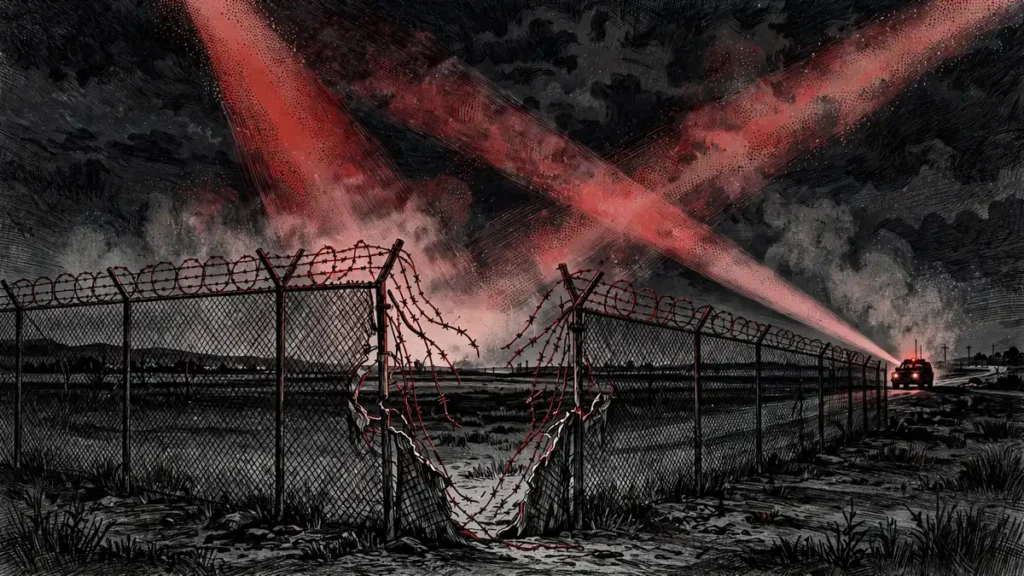
The initial arrests were made on suspicion of trespass on a prohibited site and criminal damage. Explosive Ordnance Disposal specialists examined the abandoned vehicle; nothing of concern was found, and road cordons were lifted. The men were then further arrested on suspicion of “entering a prohibited place for a purpose prejudicial to the UK” under Section 4 of the National Security Act 2023, a counter-terrorism-led offence, and detectives executed search warrants at two residential properties in the Peterborough area.
On October 9, both men were released on bail with strict conditions while the investigation continues, Reuters reported. No charges have been announced. Police have not published the men’s names, and the motive for the intrusion remains unknown.
What is RAF Molesworth — and why does it matter?
RAF Molesworth is a non-flying military installation in Cambridgeshire, about 70 miles north of London, managed by the United States Air Force. Fox News and the NY Post report it is run by the USAF’s 423rd Air Base Group; its mission is joint intelligence and command operations rather than flying operations.
The base hosts intelligence elements for US European Command (EUCOM) and US Africa Command (AFRICOM), plus the NATO Intelligence Fusion Centre — a multinational unit that supplies intelligence to the Supreme Allied Commander Europe (SACEUR). The Straits Times reports the Fusion Centre’s workforce numbers more than 200 personnel, drawing on alliance-wide staff.
Molesworth is also the site of a major US intelligence construction project. The Joint Intelligence Analysis Complex (JIAC) is a $556.5 million project, according to the US Defense Visual Information Distribution Service, which held its groundbreaking ceremony at RAF Molesworth on April 12, 2024. The facility consolidates around 1,700 intelligence personnel from roughly 20 facilities as part of the US European Infrastructure Consolidation programme, with construction expected to take about four years.
The site’s history goes back further: Fox News notes the airfield was used by US bombers in the Second World War and deactivated in 1973, while The Hindu reports the RAF founded the station in 1917. Few UK installations carry comparable sensitivity today — which is why a fence-cutting intrusion at 2 a.m. has drawn a counter-terrorism response.
Background and timeline
- June 2026: Pro-Palestinian activists broke into RAF Brize Norton and sprayed aircraft with red paint, according to the Straits Times — an early sign of rising pressure on UK military sites.
- September 27, 2026: Three suspicious vans were spotted near RAF Fairford in the early hours; a major incident was declared and seven men were arrested over the following days. All were released on bail; no charges were filed and no explosives were found.
- October 1–6, 2026: Follow-up arrests linked to the Fairford case included a dual UK-Iranian national. The prime minister said there were “strong indications” of Iranian involvement, which Iran denied, while the United States withdrew its B-1 bombers from Fairford over threat concerns.
- October 7, 2026, ~10 p.m.: Ministry of Defence Police found an abandoned vehicle near the RAF Molesworth perimeter; Cambridgeshire Constabulary was called in and a hole was found in the fence.
- October 8, 2026, ~2 a.m.: Two Latvian nationals were found inside the base perimeter and arrested on suspicion of trespass on a prohibited site and criminal damage; explosive ordnance disposal teams cleared the vehicle.
- October 8, 2026 (later): Both men were further arrested on suspicion of entering a prohibited place for a purpose prejudicial to the UK under Section 4 of the National Security Act 2023. Counter Terrorism Policing London, under Commander Helen Flanagan, took the lead; searches were carried out at two properties in the Peterborough area.
- October 9, 2026: Both men were released on bail with strict conditions; the investigation continues and no charges have been announced, Reuters reported.

What are the men accused of?
The men have not been charged with anything. Their initial arrest on suspicion of trespass on a prohibited site and criminal damage was followed by a further arrest under Section 4 of the National Security Act 2023, which covers entering a prohibited place for a purpose prejudicial to the United Kingdom. The distinction matters: under UK law, being “arrested on suspicion” of an offence is not the same as being charged.
The National Security Act, in force since late 2023, created a suite of modern counter-espionage offences, replacing much of the century-old Official Secrets Acts. The most serious charges under the Act can carry lengthy prison terms; one outlet reports the maximum sentence for a Section 4 offence as up to 14 years, though the government has not commented on potential penalties in this case.
Counter-terrorism detectives are examining the men’s movements and possible motives. Commander Helen Flanagan said investigators were keeping “an open mind” and were examining whether the intrusion was connected to “any criminal activity,” the Straits Times reported. A UK government statement described the government as “highly vigilant,” with base protection delivered through “multilayered” measures including physical barriers, patrols, surveillance, monitoring and counter-drone capabilities, according to The Hindu.
Is the Molesworth breach linked to RAF Fairford?
Police have been explicit that there is “nothing so far to suggest” the two incidents are connected, while keeping “an open mind.” That caution is understandable given the timeline. Just weeks earlier, RAF Fairford — the Gloucestershire base that hosts forward-deployed US heavy bombers — was at the centre of a major counter-terrorism operation after suspicious vans were spotted near the site in the early hours of September 27.
Seven men were arrested in connection with that incident over the following days, including a dual UK-Iranian national, and all were later released on bail with none charged. No explosives were recovered. The government said there were “strong indications” of Iranian involvement, which Tehran denied, and Washington withdrew its B-1 bombers from Fairford over the weekend, with President Trump saying the move was threat-related. You can read the full timeline in WarBrief’s RAF Fairford explainer.
The wider context is a season of pressure on UK defence sites. Beyond Fairford and Molesworth, a 24-year-old Royal Navy sailor appeared in court on October 8 charged under the National Security Act over alleged attempts to pass protected information to a foreign power, and was remanded in custody. Police have said that case is not related to the Fairford alert. For European governments tracking this pattern, the European Union has begun coordinating answers to hybrid attacks on critical sites — see WarBrief’s explainer on the EU’s emergency security protocol.
By the numbers
| Metric | Figure | Source |
|---|---|---|
| Men found inside the perimeter | 2 | Reuters / Straits Times — CONFIRMED |
| Reported ages | 32 and 36 | Reuters — REPORTED (variant ages in some outlets) |
| Time of intrusion discovery | ~2 a.m., Oct 8 | NY Post / The Hindu — CONFIRMED |
| Abandoned vehicle found | ~10 p.m., Oct 7 | The Hindu / Capital FM — CONFIRMED |
| Residential searches | 2 (Peterborough area) | NY Post / Capital FM — CONFIRMED |
| JIAC expansion cost | $556.5 million | DVIDS (US DoD) — CONFIRMED |
| Personnel the JIAC consolidates | ~1,700 | DVIDS — REPORTED (some outlets cite 1,000+) |
| NATO Fusion Centre staff | 200+ | Straits Times — REPORTED |
Figures marked CONFIRMED are stated by multiple reputable sources or official US statements; figures marked REPORTED come from single outlets or vary between sources and should be treated as provisional.
What this means for US/UK/EU readers
For UK readers, the immediate significance is domestic: a counter-terrorism investigation is now running at one of the country’s most sensitive military installations, in a year when UK defence sites have repeatedly been tested — from the Fairford vans to the Brize Norton paint attack to a serving sailor charged with spying for Russia. Expect tighter visible security around Cambridgeshire’s military sites and continued political scrutiny of how a fence could be cut at a base housing allied intelligence operations.
For US readers, the incident touches a US-run facility directly: RAF Molesworth is managed by the US Air Force and anchors EUCOM and AFRICOM intelligence work, so the breach feeds Washington’s ongoing review of force protection at overseas bases — the same review that pulled B-1s out of Fairford. No disruption to intelligence operations has been reported, and police have not said any operations were compromised.
For EU readers, the base’s NATO Intelligence Fusion Centre is a multinational asset — a disruption there would touch allied intelligence sharing across Europe. The case also lands amid a broader European conversation about hybrid threats to critical sites, from undersea cables to airbases. On everyday concerns: no travel or airspace disruption has been reported, and there is no evidence the incident affects fuel prices or markets.
What to watch next
The bail conditions expire into an active investigation. The next milestones are straightforward: whether the two men are charged or released without further action, what Commander Flanagan’s detectives find at the searched Peterborough properties, and whether the National Security Act case establishes any motive beyond the fence-cutting itself. Any statement from the US Air Force in Europe or the Ministry of Defence about changes to base security at Molesworth would also be significant.
Longer term, watch whether the UK government folds the Molesworth and Fairford incidents into a wider review of physical security at US and NATO sites in Britain — and whether the incident accelerates the $556.5 million JIAC project’s own security planning. WarBrief’s intelligence hub tracks these cases as they develop.
Frequently asked questions
Who are the two Latvian men arrested at RAF Molesworth, and are they spies?
Their names have not been published. Police describe them as Latvian nationals resident in the UK, reported as aged 32 and 36. They were arrested on suspicion of national-security offences under Section 4 of the National Security Act 2023 — which covers entering a prohibited place for a purpose prejudicial to the UK — but they have not been charged, and the motive for the intrusion is unknown. It is too early, and wrong, to characterise them as spies.
What is RAF Molesworth and why is it so important to US and NATO intelligence?
RAF Molesworth is a non-flying US Air Force installation in Cambridgeshire, about 70 miles north of London. It hosts intelligence elements for US European Command and US Africa Command, plus the NATO Intelligence Fusion Centre, which supplies intelligence to NATO’s Supreme Allied Commander Europe. A $556.5 million Joint Intelligence Analysis Complex is under construction there to consolidate around 1,700 US intelligence personnel from about 20 facilities.
Is the RAF Molesworth break-in connected to the RAF Fairford terror plot?
Police say there is “nothing so far to suggest” the two incidents are connected, but are keeping “an open mind.” The Fairford case — suspicious vans spotted on September 27, seven arrests, all bailed, none charged — is a separate counter-terrorism investigation. Both cases reflect heightened pressure on UK military sites this year.
What is the UK National Security Act 2023 and what could the men face?
The National Security Act 2023 modernised UK counter-espionage law, creating offences including entering prohibited places for purposes prejudicial to the UK. The two men were further arrested on suspicion of that offence but have not been charged. Offences under the Act can carry lengthy prison sentences; one outlet reports up to 14 years for the Section 4 offence, though no penalty has been discussed in this case.
How could someone cut through the fence of such a sensitive base — is UK base security good enough?
That is the question now facing the UK government. The intrusion was detected only after Ministry of Defence Police found an abandoned vehicle during a routine patrol, not by perimeter alarms or sensors. The government says it is “highly vigilant” and that base protection is “multilayered,” including physical barriers, patrols, surveillance, monitoring and counter-drone capabilities. Whether that layering failed at Molesworth is now part of the investigation.
Sources
- Reuters: Two men arrested at UK airbase used by US released on bail
- The Straits Times: UK counter-terror police investigating two men arrested near air base
- The Hindu: UK arrests two Latvians inside perimeter of RAF base housing US, NATO intelligence operations
- NY Post: Foreign nationals breach UK base housing key US-NATO intel hub amid $556M expansion
- Firstpost: UK military arrests 2 Latvian men at RAF base in Cambridgeshire used by US; probe underway
- US Defense Intelligence Agency: Joint Intelligence Analysis Complex project breaks ground


Discussion 0
Share analysis, corrections, or context. Be civil — comments are moderated.