WarBrief Live | October 24, 2026 | Intelligence Report
Executive summary
A third United States carrier strike group is heading to the Middle East. The USS Theodore Roosevelt carrier strike group, together with the USS Makin Island amphibious ready group carrying the 13th Marine Expeditionary Unit, is expected to arrive by late November 2026, adding an estimated 9,000 to 10,000 sailors and Marines, according to reporting by The Wall Street Journal, Bloomberg, and Fox News.
First reported on October 1, 2026, and confirmed again by US officials speaking to Fox News on October 20, the deployment widens President Donald Trump’s options after the November 3 midterm elections, when he has said increased strikes on Iran are possible. It does not mean renewed large-scale strikes have been ordered: no such decision has been announced. The open question is whether the Roosevelt will join the two carriers already in the region to make three, or relieve one of them in a planned rotation.
Read next: our Intel hub tracks US force posture in the Middle East, and our conflict zones hub follows the wider Iran confrontation.
What is heading to the Middle East?
The package has two parts. The Theodore Roosevelt carrier strike group left San Diego on Sunday, September 27, 2026, with its air wing and escorts. The Makin Island amphibious ready group sailed on Monday, September 28, carrying about 2,200 Marines of the 13th Marine Expeditionary Unit aboard USS John P. Murtha and USS Anchorage, according to Bloomberg. Together they account for roughly 9,000 to 10,000 additional personnel.
| Element | What it brings | Reported scale |
|---|---|---|
| Theodore Roosevelt carrier strike group | Carrier air wing and escorts | Part of 9,000-10,000 additional personnel |
| Makin Island amphibious ready group | Amphibious ships and aircraft | About 2,200 Marines, 13th Marine Expeditionary Unit |
| Forces already reported in the region | Two carrier strike groups in the Arabian Sea | USS George H.W. Bush and USS George Washington |
These figures are attributed to the outlets that published them. The Pentagon has not published an official deployment order for this movement.
Why does the late-November arrival window matter?
The timing is the point. Citing US Naval Institute reporting, The Media Line reported that the Roosevelt reached Yokosuka, Japan, on October 16, 2026, and departed on October 19. Two US officials confirmed the late-November arrival timetable to Fox News on October 20. That places the full force in the region after the November 3 midterm elections, when Trump has said increased strikes on Iran are possible, as reported by Bloomberg, CGTN, and The Jerusalem Post.
This report updates our earlier coverage, Third US Aircraft Carrier Heads to the Middle East as Trump Weighs Post-Midterm Iran Strikes and US Carrier Strike Groups Explained: What the Third Carrier in the Middle East Actually Means, with the transit timeline, the confirmed arrival window, and the relief-versus-surge question below.
Three carriers, or a relief in disguise?
Here the reporting diverges, and the distinction matters. If the George Washington remains when the Roosevelt arrives, the United States would have three carrier strike groups in the Middle East, the same number as in late April 2026, according to Bloomberg and CGTN. The Jerusalem Post, citing Fox News, reported on October 20 that the George H.W. Bush, which arrived in April, and the George Washington, which arrived in August to replace the Abraham Lincoln, are currently deployed in the region.
But US Naval Institute News, as reported by The Jerusalem Post, said the Roosevelt was moving to Central Command’s area to relieve the George Washington. The Media Line reached the same caution: the arrival could temporarily give Washington three carriers, or replace the George Washington in a planned rotation. Bloomberg likewise reported that no decision on maintaining three carrier groups had been made, so a three-carrier presence is a possible outcome, not a settled fact.
Bloomberg also noted that the Boxer amphibious ready group is operating near the Strait of Hormuz, and, citing Axios, that the United States has sent two additional missile batteries in recent weeks to protect oil and gas facilities in Qatar and Saudi Arabia. The missile-battery claim is attributed to Axios’s sources, not to an official Pentagon announcement.
What the package enables, and what it does not decide
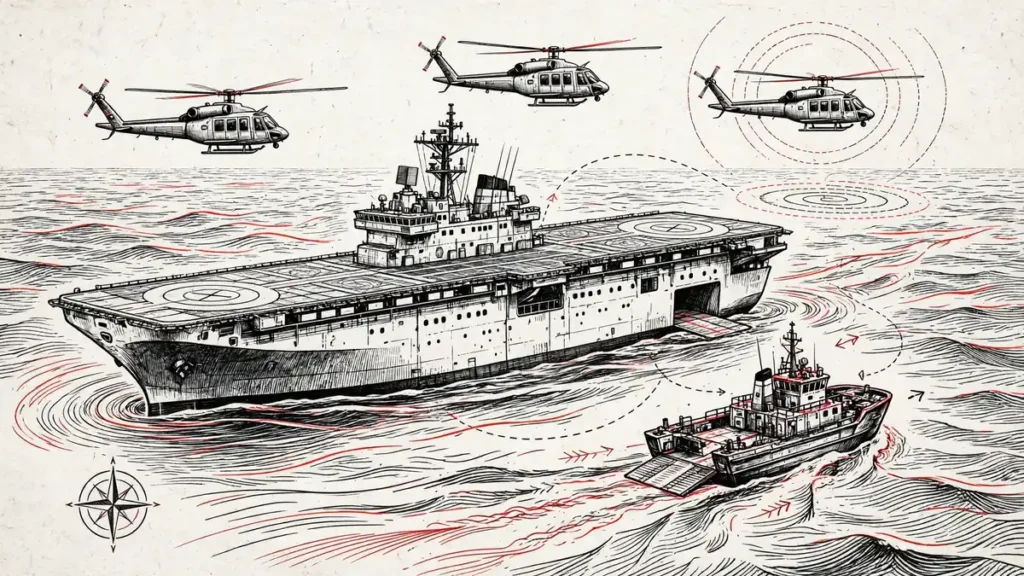
Militarily, the package adds carrier-based aircraft for strikes, air defense, and surveillance; an amphibious force that can operate ashore or threaten to do so; and a larger pool of ships for running more than one mission at once. As Fox News correspondent Jennifer Griffin wrote, quoted by The Jerusalem Post, the deployment “will provide more options for the US” as Trump considers ramping up strikes on Iran after the midterms.
The deployment also carries costs. Naval analyst Ronald O’Rourke, formerly of the Congressional Research Service, told Bloomberg that maintaining even a two-carrier presence over an extended period would strain the carrier force, and that a three-carrier presence for an extended period “would be a significantly greater strain.” Politically, it does not settle what happens next: Washington and Tehran remain divided over Hormuz shipping, according to The Media Line, and no decision to resume large-scale attacks has been announced.
Frequently asked questions
How many extra US troops are heading to the Middle East?
An estimated 9,000 to 10,000 sailors and Marines, per The Wall Street Journal and Bloomberg.
When will the third carrier arrive?
By late November 2026, according to two US officials who confirmed the timetable to Fox News on October 20, 2026.
Will the US then have three aircraft carriers in the Middle East?
Possibly. If the George Washington stays, there would be three, as in late April 2026. US Naval Institute News has also reported that the Roosevelt may relieve the George Washington, leaving two.
Does this deployment mean new strikes on Iran are certain?
No. No decision to resume large-scale attacks has been announced. The deployment is best read as expanded options and negotiating leverage, not as an order to attack.
Assessment and outlook
The Roosevelt deployment is best understood as a deliberately timed expansion of options, not a declaration of intent. Its late-November arrival places a carrier strike group plus an amphibious ready group in the region just after a politically sensitive election.
Three things will clarify the picture: whether the George Washington departs as the Roosevelt arrives, deciding between two carriers and three; whether any official statement confirms the Roosevelt’s entry into the region; and whether diplomacy moves on Hormuz shipping or nuclear inspections before the arrival window closes. If none move, the likely outcome is a larger, more visible American presence used as leverage after November 3. That is a posture, not yet a campaign.
Sources
- The Jerusalem Post: USS Theodore Roosevelt heads to Middle East amid Iran tensions (October 20, 2026)
- The Media Line: US Sends Aircraft Carrier, Thousands of Troops Toward Middle East as Iran Tensions Rise (October 20, 2026)
- Bloomberg via gCaptain: US Adds Carrier And 10,000 Troops To Mideast (October 3, 2026)
- CGTN: New aircraft carrier, 10,000 troops: What’s behind the US’ latest move in Middle East (October 3, 2026)
- Army Recognition: US Navy Deploys Two Carrier Strike Groups Near Iran to Expand Air Power Across the Arabian Sea (October 2026)