WarBrief Live | November 19, 2026 | Conflict Zone
The Strait of Hormuz, the narrow waterway that carried about a fifth of the world’s oil before the war, is effectively closed to normal commercial shipping. After nine months of the US-Israeli war on Iran, transits run about 65 percent below pre-war levels, and the United States has just tightened its naval blockade to cover the ship-to-ship transfers Iran uses to keep oil moving.
Key Takeaways
- Shipping through the strait is about 65 percent below pre-war levels, with 308 crossings in the week ending November 11, according to UK Maritime Trade Operations.
- A November 18 CENTCOM advisory treats ship-to-ship transfers of Iranian cargo as blockade evasion, closing the main route Iran used to export oil around the blockade.
- Attacks escalated on November 16-18: tankers hit near Oman, an unverified Iranian mine claim, a US strike on Qeshm Island, and Iranian attacks on US facilities in Kuwait and Bahrain.
- War-risk insurance has surged to 7.5-10 percent of a vessel’s hull value, against 1-3 percent before the war.
Overview: the world’s most important oil chokepoint
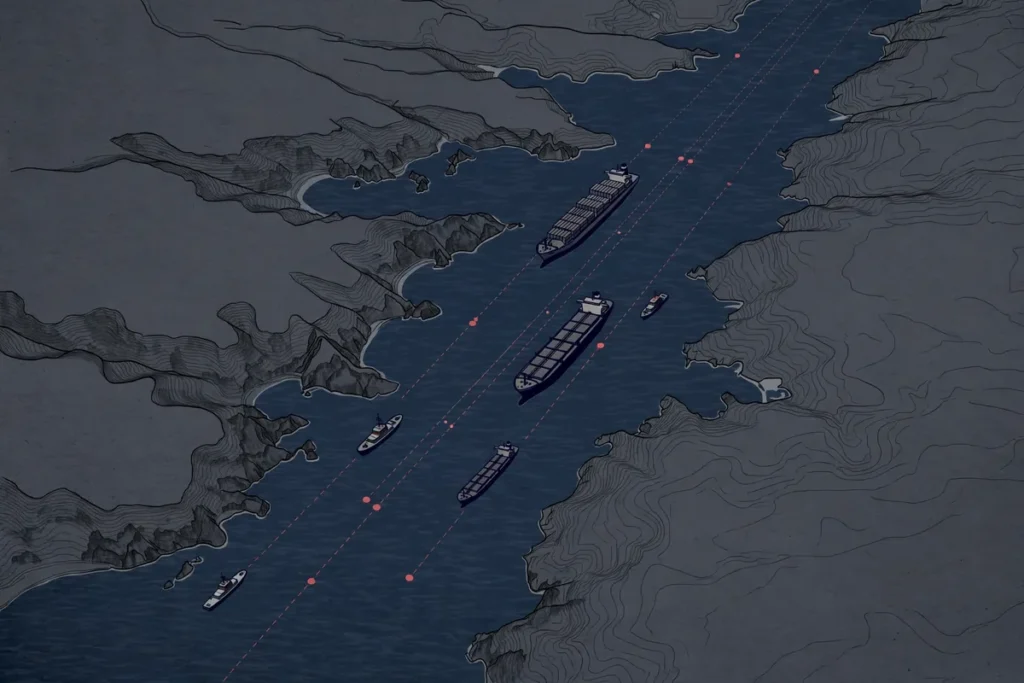
The Strait of Hormuz is the only sea route from the Persian Gulf to the Arabian Sea and the open ocean beyond. Before the war it carried about a fifth of the world’s oil supplies, along with liquefied natural gas, fertiliser and other essential goods from Gulf producers. Kpler ship-tracking data put combined crude and product flows at about 17.1 million barrels a day before the war. That makes the strait the single most consequential maritime chokepoint in the global energy system, and the reason it sits at the centre of the Iran war. For the wider map of active conflicts, see our Conflict Zones hub, and for how Hormuz compares with the war’s other great chokepoint, see Bab el-Mandeb vs Strait of Hormuz.
Since February 28, 2026, when the United States and Israel launched strikes on Iran, the strait has been governed by two competing sets of rules. Iran demands that vessels use approved routes and coordinate with its forces, and says it controls passage. The United States enforces a naval blockade of Iranian ports and says neutral transit passage to non-Iranian destinations is not impeded. Commercial shipping is caught between the two.
Key actors in the strait
Iran. The Revolutionary Guard Navy and Iran’s regular navy patrol the strait, and Tehran runs a Strait Authority issuing permits and charging fees. Iran has announced exemptions for ships from India, China, Iraq and Qatar, and its approved route runs much closer to its own coastline than the lanes ships used before the war.
The United States. US Central Command and the US Navy’s 5th Fleet, based in Bahrain, enforce the blockade and say they escort shipping through the strait. President Donald Trump has insisted the campaign against Iran is effectively over and that US escorts have secured the waterway, a claim the continuing attacks call into question.
Israel. Israel is pressing Washington to join a four-to-seven-day air campaign against Iran, targeting nuclear sites, missile capabilities and energy infrastructure, according to reporting by The New York Times carried by Haaretz.
The Gulf Arab states. Saudi Arabia, the United Arab Emirates, Qatar, Kuwait and Bahrain are both the exporters whose oil must cross the strait and the hosts of the US bases now being targeted. Their governments, along with Pakistan and Turkey, are engaged in concerted diplomacy to prevent a resumption of all-out war, according to regional officials cited by the Associated Press.
Recent developments in the Strait of Hormuz
- February 28, 2026: The United States and Israel launch strikes on Iran. Iran in effect closes the strait, allowing only some ships to pass while targeting vessels it considers unauthorised.
- April 13, 2026: The US naval blockade of Iranian ports is first imposed. It is lifted in June after a draft understanding with Tehran, then reimposed on July 14 after the agreement collapses.
- November 16, 2026: UKMTO reports two tanker attacks near Oman, including one vessel left disabled with its engine room on fire. A commercial LPG carrier is hit twice about seven nautical miles north of Khasab; its crew of 25 abandons ship and one crew member is reported missing, according to maritime intelligence firm Windward.
- November 17, 2026: Iranian forces claim three tankers struck naval mines in the southern strait. The claim is unverified: Iran named no vessels, and no mine strike has been independently confirmed. For how such weapons work, see How Naval Mines Work.
- November 17, 2026: US forces strike an IRGC missile site on Qeshm Island, hours after an Iranian drone attack targeted a US radar installation in Bahrain. ADNOC Logistics and Services says one of its vessels was attacked while transiting the strait the same day. See US Strikes Qeshm Island After Iran’s Bahrain Attack.
- November 17, 2026: Acting US Navy Secretary Hung Cao tells a Senate hearing that insurance for a single transit has risen to $64 million, against $54,000 before the war. The figure has not been independently verified.
- November 18, 2026: CENTCOM advises that any ship receiving cargo via a ship-to-ship transfer from a vessel carrying cargo loaded at an Iranian port or coastline may be considered to be evading the blockade, even if it never entered Iranian waters. Such ships may be stopped, boarded, diverted or captured.
- November 18, 2026: Iran widens its attacks on Gulf neighbours, targeting a US air base in Kuwait and launching several attacks on Bahrain, in apparent retaliation for the Qeshm strike. It is the first such Iranian attack on US facilities in Bahrain in about two months.
- November 19, 2026: Gulf states, Pakistan and Turkey accelerate diplomatic efforts to avert all-out war as Netanyahu presses the Trump administration for a joint four-to-seven-day air campaign, the Associated Press reports.
Current status: closed in practice, open on paper
The strait is technically open, but not in any sense a shipowner would recognise from before the war. UKMTO recorded 308 vessel crossings in the seven days ending November 11, 169 inbound and 139 outbound, approximately 65 percent below pre-war levels. Kpler put Hormuz crude and product flows at about 8.3 million barrels a day in the week to November 11, roughly 48 percent of the pre-war level, and Brent crude traded at about $92 a barrel on November 18.
The economics of sailing the strait have changed even more than the traffic counts. S&P Global reported in July that war-risk insurance premiums had reached 7.5 to 10 percent of a ship’s hull value, against 1 to 3 percent before the war, implying insurance of about $21 million for a tanker carrying 270,000 metric tonnes of crude. Reuters reported in September that moving an oil cargo through Hormuz cost roughly $10 million to $20 million. Cao’s $64 million figure would sit well above those benchmarks, which is why analysts have treated it with caution.
| Metric | Figure | Source |
|---|---|---|
| Weekly vessel crossings, week ending Nov 11 | 308 (169 inbound, 139 outbound) | UKMTO |
| Crossings vs pre-war levels | About 65% below | UKMTO |
| Crude and product flows, week to Nov 11 | About 8.3 million barrels a day | Kpler |
| Flows vs pre-war (about 17.1 million bpd) | About 48% | Kpler |
| War-risk insurance premium | 7.5-10% of hull value (was 1-3%) | S&P Global, July 2026 |
| Single-transit insurance claim | $64 million (NOT independently verified) | Acting Navy Secretary Hung Cao, Nov 17 |
| Brent crude, Nov 18 | About $92 a barrel | Reuters market data |
Figures marked CONFIRMED come from two or more reputable sources. The $64 million insurance figure is a single official’s claim and is labelled REPORTED until independently verified.
Iran’s crude exports have remained near a standstill for months, according to shipping sources cited by Reuters, although Iran has managed to export some liquefied petroleum gas and jet fuel since July despite the blockade. The November 18 advisory is aimed squarely at that remaining trade: by treating the receiving vessel in a ship-to-ship transfer as a blockade evader, CENTCOM closes the workaround that let Iranian cargo reach market without the carrying vessel ever entering an Iranian port.
What to watch in the Strait of Hormuz
Five developments will decide whether the strait stabilises or deteriorates further. First, the trilateral meeting of Presidents Trump, Putin and Xi in Shenzhen today, where the Iran war and the expiry of the New START treaty are on the agenda. Second, whether Trump accepts Netanyahu’s request for a four-to-seven-day joint air campaign, or holds to the position, voiced by a US official, that economic pressure has already made major new combat operations unnecessary. Third, whether Iran’s claim that three tankers struck mines is verified by any independent source. Fourth, whether CENTCOM acts on its November 18 advisory by stopping or boarding a vessel after a ship-to-ship transfer. Fifth, Iran’s standing offer, repeated by Foreign Minister Abbas Araghchi, to reopen the strait within seven days of a US acceptance, first made in mid-September, which remains the clearest off-ramp on the table.
Frequently asked questions
Is the Strait of Hormuz open?
Technically yes, but it is effectively closed to normal commercial traffic. Some vessels still cross, often with transponders off or under naval escort, but UKMTO recorded only 308 crossings in the week ending November 11, about 65 percent below pre-war levels.
Why is the Strait of Hormuz so important?
It is the only sea route from the Persian Gulf to the open ocean, and before the war it carried about a fifth of the world’s oil supplies, plus liquefied natural gas, fertiliser and other essential goods from Gulf producers.
What is the US blockade of Iran?
A CENTCOM-enforced naval blockade of Iranian ports, first imposed on April 13, 2026, lifted in June and reimposed on July 14. A November 18 advisory extends it to ship-to-ship transfers: any vessel receiving cargo loaded at an Iranian port may be stopped, boarded, diverted or captured.
Who controls passage through the strait?
Both sides claim control. Iran demands vessels use approved routes and coordinate with its forces, with exemptions for ships from India, China, Iraq and Qatar. The United States says neutral transit passage to non-Iranian destinations is not impeded, while reserving the right of visit and search.
Sources
- Reuters: US tightens Iran blockade with curbs on oil transfers at sea, advisory shows
- Al Jazeera: US official says Hormuz insurance hits $64m: Is the strait really open?
- gCaptain (Reuters): US targets ship-to-ship transfers in expanded Iran maritime blockade
- Associated Press via The Week: Mideast nations ramp up efforts to avert all-out war as Israel urges Iran strikes
- Outlook India: Strait of Hormuz shipping crisis: $64 million insurance costs, Iran war and US blockade
- Strategic Energy Map: Strait of Hormuz: is it open? Status, ship traffic and oil flows