WarBrief Live | November 18, 2026 | Country Profile
Colombia’s military is the largest counter-insurgency force in Latin America, with about 285,000 active service members, a fighter fleet in the middle of a generational change, and a new president who has ended peace talks and ordered a military crackdown. On November 18, 2026, US Defense Secretary Pete Hegseth visits Bogota to hand over the first of three promised C-130 Hercules transport aircraft, the most visible sign yet of a security partnership being rebuilt after two years of strain.
Key Takeaways
- Colombia counts about 285,000 active service members (IISS, The Military Balance 2026) and spends $8.3 billion on defense under the IISS measure; SIPRI’s broader measure, which also counts paramilitary forces, puts 2025 spending at $14.5 billion, or 3.2% of GDP.
- Its Kfir fighter fleet is down to five airworthy aircraft, according to Janes, and stays in service only until October 2027; 17 Saab Gripen E/F jets ordered in November 2025 for 3.1 billion euros are the replacement.
- President Abelardo de la Espriella, sworn in on August 7, 2026, ended all peace negotiations with illegal armed groups on September 11, 2026, and has ordered a military-led crackdown backed by deeper cooperation with the United States.
- Colombia joined the US-led Shield of the Americas initiative in August 2026, and Hegseth’s November 18 visit brings the first C-130 Hercules handover, with two more aircraft expected.
Overview
Colombia is a country of about 50 million people with coasts on both the Caribbean Sea and the Pacific Ocean, borders with Venezuela, Brazil, Peru, Ecuador and Panama, and a six-decade internal armed conflict that has killed some 450,000 people and displaced millions, according to Reuters. The 2016 peace deal with the Revolutionary Armed Forces of Colombia (FARC) demobilized more than 14,000 fighters, but dissident FARC factions, the National Liberation Army (ELN) and the Clan del Golfo criminal organization never stopped fighting, and their combined membership grew through the 2020s. The International Crisis Group reported in August 2026 that there were more irregular combatants in Colombia than at any moment since the 2016 accord, with total estimated membership nearly doubling between 2022 and 2025.
That is the landscape the Military Forces of Colombia are built for. Unlike most of its neighbors, Colombia’s armed forces are organized around counter-insurgency, counter-narcotics and territorial control rather than conventional war against another state. The army is the dominant service, the air force is built around helicopters and light attack aircraft, and the navy splits its effort between the Caribbean, the Pacific and the country’s river systems. The force is also one of the most combat-experienced in the hemisphere: it has fought a continuous internal war for decades, with US support under Plan Colombia and its successors.
Military capabilities
Colombia’s active armed forces number about 285,000, according to the International Institute for Strategic Studies’ The Military Balance 2026, cited by Business Insider, with a defense budget of $8.3 billion on the IISS measure. Broader counts run higher because they include paramilitary and police elements: Global Firepower ranks Colombia 43rd of 145 countries in its 2026 index and counts 429,000 active personnel, while SIPRI’s Military Expenditure Database puts 2025 spending at $14.5 billion, or 3.2% of GDP, the 31st highest in the world. The figures are not contradictory; they measure different things, and the IISS figure is the standard count of uniformed armed-forces personnel.
| Metric | Figure | Source |
|---|---|---|
| Active armed forces | 285,000 | IISS, The Military Balance 2026 |
| Defense budget (IISS measure) | $8.3 billion | IISS, The Military Balance 2026 |
| Defense spending (SIPRI measure, 2025) | $14.5 billion (3.2% of GDP) | SIPRI Military Expenditure Database |
| Global Firepower rank (2026) | 43 of 145 | Global Firepower |
| Total aircraft | 430 | Global Firepower |
| Air force personnel | 25,000 | Colombian Aerospace Force |
Figures from different databases use different definitions. IISS counts uniformed armed-forces personnel; SIPRI’s spending measure also covers paramilitary forces, and Global Firepower’s personnel count is broader still.
The Colombian Aerospace Force, renamed from the Air Force in November 2024, counts about 25,000 active personnel and 276 aircraft. Its fighter arm is its weakest link. The fleet of Israeli-built IAI Kfir jets, the country’s only supersonic fighters, has shrunk to five airworthy aircraft, defense-sector sources told Janes on November 4, 2026, and the fleet is expected to stay in service only until October 2027, when technical support for its ejection seats ends. The replacement is already contracted: in November 2025 Colombia signed a deal for 17 Saab Gripen E/F multirole aircraft from Sweden, worth 3.1 billion euros, with deliveries planned between 2026 and 2032. Until the Gripens arrive, the air war is carried by 24 Embraer A-29 Super Tucano light attack aircraft, a large UH-60 Black Hawk helicopter fleet, and transport aircraft including the C-130, C-295 and C-212. The C-130 that Hegseth hands over on November 18 directly strengthens the weakest part of that mix: airlift into remote areas where roads do not reach.
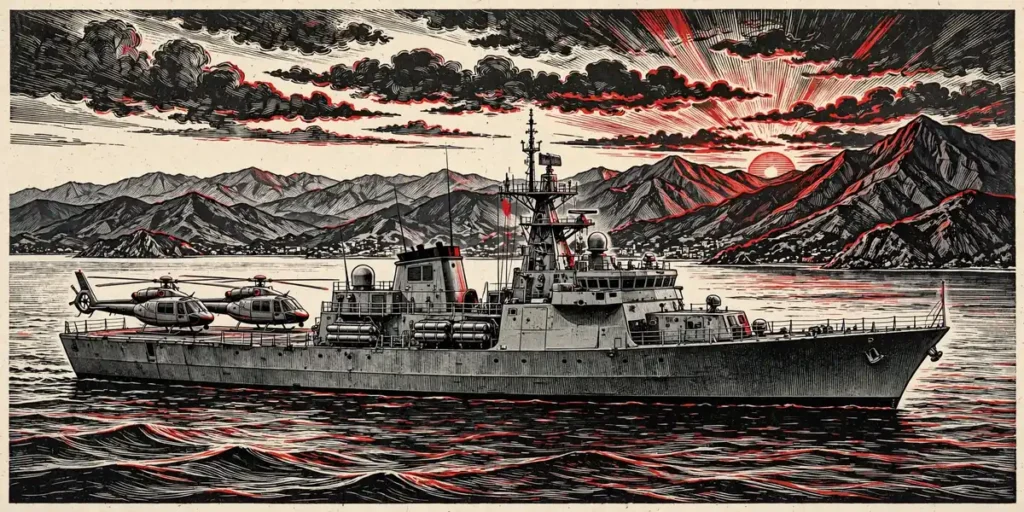
The navy operates four Almirante Padilla-class missile frigates, built in Germany and commissioned in 1983-1984, modernized under the Orion program, and four submarines: two German-built Type 209/1200 boats and two smaller Type 206 boats. The fleet is rounded out by offshore patrol vessels and a large patrol-boat force for counter-narcotics work on both coasts and in the rivers. The frigate ARC Almirante Padilla returned to Cartagena on October 5, 2026, after representing Colombia at UNITAS 2026, the longest-running multinational maritime exercise in the Americas. Five new SIGMA 10514 frigates, built domestically by Cotecmar, are planned to replace the aging Padilla class from 2026 onward. The army, the largest service, is built around light infantry, special forces and aviation brigades, with no main battle tank fleet; its striking power is mobility, helicopters and air support rather than armor.
Alliances and posture
Colombia is the United States’ closest military partner in South America. It became NATO’s first Latin American global partner in May 2017, and in March 2022 President Joe Biden designated it a major non-NATO ally of the United States, a status that brings additional defense trade and security-cooperation benefits without the mutual-defense guarantee of NATO membership. The partnership survived a sharp deterioration in relations during the second Trump administration, when Washington imposed sanctions on then-President Gustavo Petro, and has been restored since de la Espriella’s election, with bilateral cooperation rebuilt around counter-narcotics and counter-insurgency.
The newest layer of that partnership is the Shield of the Americas, a US-led multinational military initiative aimed at drug cartels and other transnational criminal actors, which Colombia joined in August 2026, according to Reuters. The initiative now counts about 20 member countries across the Americas. Colombia’s posture within it is that of the frontline state: the country is the world’s largest cocaine producer, and its Caribbean and Pacific coasts are the main departure routes for shipments to the United States and Europe. For Washington, Colombia’s value is geographic and operational; for Bogota, the value is equipment, intelligence and political backing for a crackdown the new government has promised at home. Readers can compare the scale of the US commitment with our profile of the United States military capabilities, and browse all our profiles on the country hub.
Current developments
The sharpest change in Colombia’s security posture came on September 11, 2026, when President de la Espriella formally ended all peace negotiations with illegal armed groups, revoking the credentials of government negotiators and declaring an end to the dialogue mechanisms of his predecessor Gustavo Petro’s “Total Peace” policy. The decision ended talks with the ELN, FARC dissident factions, the Clan del Golfo and urban gangs in Medellin, Buenaventura and Quibdo. De la Espriella offered the groups two options: surrender and face the justice system, or face military action. His government has since restarted coca eradication, expanded aerial bombardment, militarized some cities and created joint task forces to defend strategic assets, including a pipeline running from the Caribbean coast to central Colombia.
Violence has intensified since the new government took office. On November 8, 2026, a drone attack on a military base in northern Colombia killed three soldiers and injured at least 16, the army said, in an area disputed by the Gulf Clan, the ELN and FARC dissidents. Armed groups have also adopted drones of their own, a threat the military is still adapting to. Against that backdrop, Hegseth’s visit on November 18 is the first by a US defense secretary to Colombia under the new government. Defense Minister Jorge Eduardo Mora told Congress on November 17 that Hegseth would hand over a first Hercules C-130 aircraft in Bogota and that two more are coming, and that the two sides would discuss security cooperation. Regional media reported that Hegseth planned to visit Venezuela after his stop in Colombia; that onward visit has not been confirmed by the Pentagon.
What to watch next is whether the equipment and the crackdown change the facts on the ground. The Gripen deliveries, the C-130 handovers and the Shield of the Americas give Colombia more tools than it has had in years, but the armed groups it faces have grown through every previous offensive, and the Kfir gap means Colombia’s air-defense cover will stay thin until the late 2020s. The test of de la Espriella’s hard-line turn will be measured in territory retaken and commanders captured, not in aircraft delivered.
Frequently asked questions
How large is Colombia’s military?
Colombia has about 285,000 active service members, according to the IISS The Military Balance 2026, making it one of the largest armed forces in Latin America. Broader counts that include paramilitary forces run higher, at 429,000 in Global Firepower’s 2026 index.
What fighter jets does Colombia fly?
Colombia’s only supersonic fighters are Israeli-built IAI Kfir jets, of which only five were airworthy in November 2026, according to Janes. They are due to retire in October 2027 and will be replaced by 17 Saab Gripen E/F aircraft ordered from Sweden in November 2025 for 3.1 billion euros.
Is Colombia a NATO member?
No. Colombia is a NATO global partner, the first Latin American country to hold that status, and a major non-NATO ally of the United States, designated in March 2022. Neither status carries NATO’s mutual-defense guarantee.
Why is the US defense secretary visiting Colombia?
Pete Hegseth is visiting Bogota on November 18, 2026, to deliver military equipment, including the first of three promised C-130 Hercules transport aircraft, and to discuss security cooperation with the government of President Abelardo de la Espriella, which ended peace talks with armed groups in September 2026 and joined the US-led Shield of the Americas in August 2026.
Who is Colombia fighting?
Colombia’s armed forces fight the National Liberation Army (ELN), dissident factions of the former FARC guerrillas, and the Clan del Golfo criminal organization, along with smaller armed groups, in a conflict over drug trafficking routes, illegal mining and territorial control.
Sources
- Reuters: Hegseth to visit Colombia on Wednesday to deliver military equipment
- Free Malaysia Today (Reuters): Hegseth to visit Colombia for military cooperation talks
- International Crisis Group: From “Total Peace” to Iron Fist: Colombia’s Risky Turn to Hard Security (Briefing No. 56, August 2026)
- Janes: Colombia to keep Kfir fighter jets operational until October 2027
- 1News (AP): Drone attack on a Colombian military base leaves 3 soldiers dead
- DefenseMatrixLab: Colombia military strength 2026 (IISS Military Balance 2026 and SIPRI data)
- Global Firepower: Colombia Military Strength 2026
- AnewZ: Colombia ends peace talks with armed groups