WarBrief Live | October 31, 2026 | Country Profile
Australia is a mid-sized Indo-Pacific military power reshaping itself for long-range deterrence, held together by the US alliance and a widening circle of regional partners.
Key Takeaways
- Marles said on October 29, 2026, that China’s buildup is creating a “condition of pressure” in Southeast Asia.
- The “Squad” met at ADMM-Plus in Cebu, pledging greater defence policy coordination.
- Defence spending: A$58.99 billion budgeted for 2025-26, about 2.05 percent of GDP, rising toward 2.3 percent by the early 2030s.
- AUKUS submarines are the long-term centrepiece, but the first boats are years away.
Overview: a continent with northern approaches
Australia is a vast continent with a small population, long northern sea and air approaches, and trade routes through Southeast Asia and the South China Sea. Defence planning therefore concentrates on holding an adversary at risk far from the mainland, not on defending a land border.
The 2023 Defence Strategic Review and the 2024 National Defence Strategy replaced a balanced force with a “strategy of denial”: long-range missiles, submarines and aircraft meant to complicate any move against Australia or its region.
What Australia’s military can do today
The Australian Defence Force (ADF) is a professional, all-volunteer force. Budget papers for 2025-26 reset the permanent ADF target to 59,373, with a plan to reach about 69,000 by the early 2030s. The army (roughly 30,000 regulars) is being reshaped for littoral operations, with Boxer and Redback vehicles and HIMARS launchers.
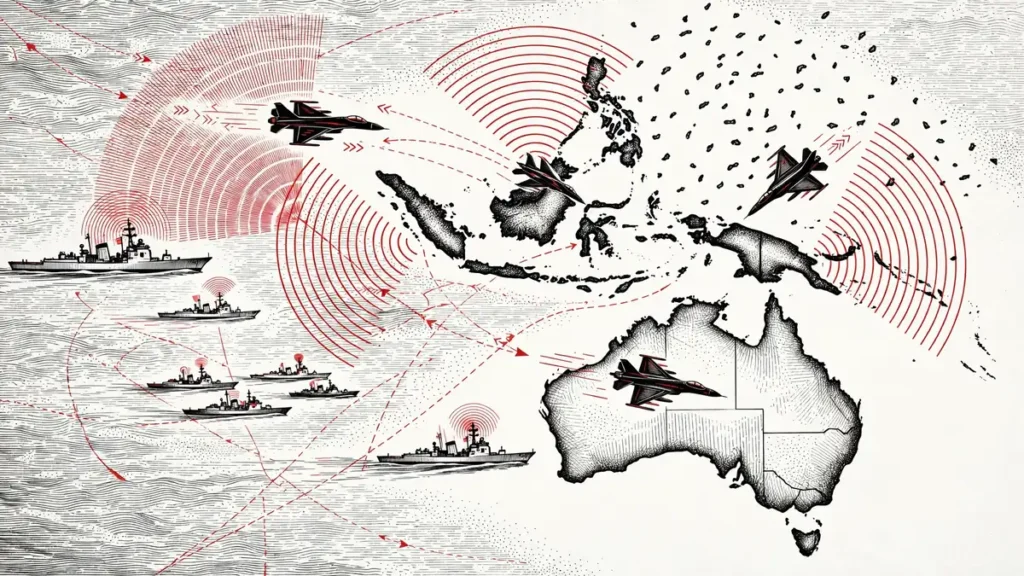
Air power centres on 72 F-35A fighters, supported by Growler, Poseidon, Wedgetail and Triton aircraft. At sea, six Collins-class diesel-electric submarines are being life-extended while Australia waits for nuclear-powered boats.
By the numbers
| Metric | Figure | Source |
|---|---|---|
| Defence budget, 2025-26 | A$58.99 billion (about 2.05% of GDP) | Budget reporting |
| Planned defence share of GDP | About 2.3% by the early 2030s | Government plan |
| Permanent ADF target, 2025-26 | 59,373 personnel | Budget papers |
| F-35A fighters | 72 | Defence reporting, 2026 |
| Collins-class submarines | 6, being life-extended | Defence reporting, 2026 |
| Virginia-class submarines planned | 3 to 5, from the early 2030s | AUKUS plan |
How do the Squad, the Quad and AUKUS fit together?
Australia sits in three overlapping circles: the ANZUS alliance with the United States, underpinned by Five Eyes intelligence sharing; the Quad, with the United States, Japan and India; and AUKUS, the 2021 technology and submarine pact with the United States and the United Kingdom.
The newest circle is the “Squad”: Australia, Japan, the United States and the Philippines, an informal grouping, not a treaty alliance, focused on maritime cooperation around the South China Sea and the First Island Chain. Its ministers met in Kuala Lumpur in November 2025 and again in Cebu in October 2026, and Philippine officials stress it does not replace ASEAN-centred forums such as ADMM-Plus.
Under AUKUS, Australia plans to buy three to five US Virginia-class submarines from the early 2030s, then build SSN-AUKUS boats with Britain from the early 2040s. It is the largest, most expensive program in Australian history, and its schedule depends in part on already-stretched American shipyards.
What changed at Cebu in October 2026?
At the 13th ADMM-Plus in Cebu on October 28-29, 2026, Defence Minister Richard Marles told reporters on October 29: “We’re obviously seeing the biggest conventional military build-up that the world has seen since the end of the Second World War from China.” He added: “There’s not an explanation from China as to why it’s doing this, and all of that is creating the condition of pressure.”
Marles said the Squad ministers had committed to greater defence policy coordination. US Secretary of War Pete Hegseth described the session as moving “beyond words to practical cooperation” along the First Island Chain, from Japan through Taiwan to the Philippines. No joint statement with specific new commitments had been released.
Beijing sent only its Manila defence attaché rather than its defence minister; its ministry said the Philippines had obstructed its participation, while Manila said China had been invited. In July 2026, Australia had separately protested a Chinese nuclear-capable missile test in the South Pacific, calling it destabilising. For US, UK and European readers, Cebu shows smaller Indo-Pacific groupings hardening into regular habits, and Australian submarine, missile and basing decisions shaping what allies can do in a regional crisis.
What to watch next in Australia’s military buildup
Three tests lie ahead: the Virginia-class timetable, funding toward 2.3 percent of GDP and recruitment to 69,000, and whether ASEAN accepts the Squad as a complement to ADMM-Plus. See also the country hub, South China Sea profile, ADMM-Plus report and Philippines profile.
Frequently asked questions
Is Australia in NATO?
No. It is a close US ally through ANZUS and a Five Eyes partner, and it takes part in the Quad, AUKUS and the Squad, but it has no NATO obligation.
When will Australia get nuclear-powered submarines?
Three to five US Virginia-class boats are planned from the early 2030s, then SSN-AUKUS boats from the early 2040s. Until then, six life-extended Collins-class boats carry the task.
What is the Squad?
An informal grouping of Australia, Japan, the United States and the Philippines, focused on Western Pacific maritime cooperation. It is not a treaty alliance; its ministers met most recently in Cebu in October 2026.
How much does Australia spend on defence?
A$58.99 billion in 2025-26, about 2.05 percent of GDP, with a plan to reach about 2.3 percent by the early 2030s.
Sources
- Agence France-Presse via Cebu Daily News: Australian defense chief: China military buildup creating ‘pressure’ in SE Asia
- Philstar: To boost ASEAN security cooperation: 5 new initiatives
- Australian Defence Magazine: Defence budget inches upwards
- ANU Reporter: Defence spending – a question of capability
- Defense and Tech: Squad Defence Ministers Meeting in Cebu