WarBrief Live | October 28, 2026 | Country Profile
Japan is accelerating a military buildup that would have been politically unthinkable a decade ago. Under Prime Minister Sanae Takaichi, Tokyo has reached its old 2% of GDP defence target ahead of schedule, requested a record budget for the next fiscal year, and is rewriting the three documents that set its security strategy, while the United States presses for more still.
Key Takeaways
- Japan’s Defence Ministry requested a record 8.9 trillion yen for fiscal 2027, including 17 MQ-9B surveillance drones and hypersonic missile funding.
- The next five-year plan is projected at 60 trillion to 80 trillion yen, up from 43 trillion yen in the current plan.
- Washington demands 3.5% of GDP; Tokyo is considering counting AI, infrastructure, energy security and development aid toward that total.
- Japan’s posture remains alliance-centred: the US-Japan alliance, the Quad, and growing ties with the Philippines, Australia and India.
Overview
Japan’s armed forces are the Self-Defense Forces: the Ground, Maritime and Air Self-Defense Forces, operating under a constitution that renounces war and a policy of an exclusively defence-oriented posture. That framework has not been discarded, but its practical meaning has changed. The National Security Strategy revised in December 2022 explicitly adopted counterstrike capabilities: the ability, after Japan has come under armed attack, to strike targets such as missile launch bases in an adversary’s territory to prevent further attacks. Related profiles are collected on WarBrief’s country hub.
Tokyo cites increased Chinese activity around Japan and Taiwan, North Korea’s nuclear and missile programmes, and closer Russia-North Korea military cooperation. Beijing has criticised the buildup, and critics at home warn against a budget driven by a spending target rather than assessed needs.
Military capabilities
Japan’s priorities are unmanned systems, long-range strike, integrated air and missile defence, space and cybersecurity. Its fiscal 2027 request, submitted in late August 2026 for the fiscal year beginning in April 2027, totals a record 8.9 trillion yen, about $56 billion, and is 0.9% higher than the current fiscal year’s initial allocation, according to reporting on the ministry’s filing.
The request includes 292 billion yen for 17 MQ-9B SeaGuardian unmanned aircraft for maritime surveillance, and 167 billion yen for hypersonic missiles and related equipment. It also seeks funding for other long-range missiles, including US-made Tomahawk cruise missiles, and for expanded domestic missile production and ammunition stockpiles. About 160 items were left unpriced, to be costed once the revised security documents are finalised, so the 8.9 trillion yen figure is a floor for negotiation rather than a final budget.
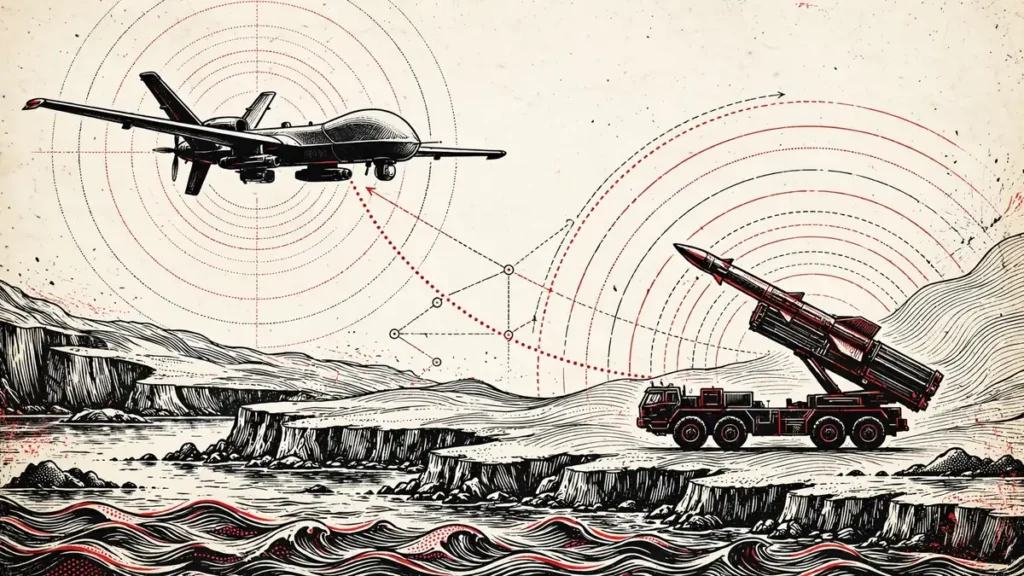
At sea and in the air, Japan fields a modern force of destroyers, submarines, fighters and maritime patrol aircraft, much of it interoperable with US systems. The emphasis is shifting from platforms alone to networks: AI for intelligence gathering, satellite tracking of mobile targets, and resilient command and control.
Alliances & posture
Japan’s posture is anchored in its alliance with the United States, the foundation of its defence planning and the source of many major weapons systems. That dependence also binds Tokyo to US supply chains and doctrine, so shifts in Washington’s demands reverberate directly in Tokyo’s budget debate.
Beyond the alliance, Japan is in the Quad with the United States, Australia and India, and has deepened cooperation with the Philippines, Australia and India, including joint exercises. Its posture is most visible in the southwest island chain facing the East China Sea and Taiwan Strait. For US, British and European readers, it is the largest US ally’s answer to Chinese pressure, and a test of how far Washington can push allies to spend more.
Current developments
The immediate trigger for this profile is the year-end revision of Japan’s three security documents: the National Security Strategy, the National Defense Strategy and the Defense Buildup Program. The current five-year programme, adopted in 2022, envisaged about 43 trillion yen over fiscal 2023 to 2027. Projections reported by the Nikkei newspaper put the next plan at 60 trillion to 80 trillion yen, yet Nikkei-based estimates still put annual spending of about 20 trillion yen as needed to reach 3.5% of GDP.
That gap explains the accounting debate reported on October 24, 2026: the Takaichi cabinet is considering counting AI, energy security, infrastructure and development aid outside the Defence Ministry budget as defence spending. The Straits Times reported Tokyo is considering a 3.5% target, while noting 3% is also possible. Finance Minister Satsuki Katayama said on October 20 that the government had not yet chosen how to pay for an increase, and a Mainichi editorial warned unused appropriations since fiscal 2023 total around 1 trillion yen.
On October 28, Defence Minister Shinjiro Koizumi was in Cebu for the ASEAN Defence Ministers’ Meeting-Plus, meeting US Defense Secretary Pete Hegseth and Indian Defence Minister Rajnath Singh, ahead of the ASEAN summit in Manila. Kyodo News reported Koizumi and Hegseth agreed on increased defence investment and strategic alignment, including an effective denial defence in the First Island Chain. Reporting on October 28 also said Japan plans to make “denial capability” – convincing an adversary that an attack cannot succeed – a central pillar of the revised documents.
What to watch next
Watch whether the revised documents name a 3.5% target or a large five-year total; the negotiations pricing the roughly 160 uncosted items; and whether the AI, infrastructure and aid accounting change is adopted. The previous Japan profile, published in January 2026, predates these decisions.
Frequently asked questions
How much is Japan spending on defence?
Japan requested a record 8.9 trillion yen, about $56 billion, for fiscal 2027, 0.9% more than the current year’s initial allocation. It is a request, not an approved budget, and about 160 items were left unpriced.
What is the 3.5% of GDP demand?
The United States has demanded Japan raise defence spending to 3.5% of GDP. Nikkei-based estimates cited in October 2026 put the annual spending needed at about 20 trillion yen, well above the current request.
Does Japan have counterstrike missiles?
Yes, in policy and increasingly in hardware. The 2022 strategy adopted counterstrike capabilities, and Japan is acquiring Tomahawk cruise missiles and developing domestic long-range and hypersonic missiles.
Is Japan in NATO?
No. Japan is not a NATO member. Its core alliance is with the United States, supplemented by the Quad and bilateral partnerships in the Indo-Pacific.
Sources
- Caliber: Japan seeks record defence budget as PM plans military buildup
- Aju Press: Japan considers including AI and infrastructure in defense budget amid US pressure
- The Straits Times: Japan may spend 3.5% of GDP on defence after US pressure
- Nikkei Asia: ASEAN and Quad defense chiefs give the Philippines a diplomatic test
- Kyodo News: Japan, US defense chiefs agree to boost deterrence amid China clout
- Mainichi: Editorial: Japan gov’t linking defense buildup to growth risks runaway spending