
WarBrief Live | October 26, 2026 | Breaking Analysis
Israel votes on October 27, 2026, in an election that Prime Minister Benjamin Netanyahu has turned, in its final hours, into a test of security. On October 25, two days before polling, Netanyahu warned in a video recorded in front of an Arrow missile-defence battery that Iran and its proxies could try to disrupt the vote, and he threatened what he called disproportionate blows in response. At the same time, an estimated 67,000 Israelis living abroad are travelling home to cast ballots in person, in a contest where the final polls put neither main bloc near the 61 seats needed to govern. This is the Israel election October 27 2026 story in full: what Netanyahu warned, what is confirmed, what remains reported, and what happens next.
Key Takeaways
- Netanyahu said on October 25 that Israel had intelligence signs Iran and its proxies could attack to disrupt the October 27 election. He published no evidence, and no target, timing or method was disclosed.
- Israel’s defence minister denied on October 26 that Israel intended to attack Iran before the election, after Israeli media reported a dispute between Netanyahu and the army chief.
- About 67,000 overseas Israelis are estimated to be travelling home to vote. That is an organiser estimate based on surveys and registration data, not a confirmed count of arrivals.
- Final polls put Gadi Eisenkot’s bloc ahead of Netanyahu’s bloc, but neither bloc reaches 61 of the Knesset’s 120 seats, pointing to difficult coalition talks after the vote.
What did Netanyahu warn on October 25?
Standing at the Palmahim air base in front of an Arrow anti-ballistic missile battery, Netanyahu said the Israel Defense Forces were prepared for both defence and offence. The Times of Israel reported his words as: “We have intelligence signs that Iran and its proxies could challenge us with attacks in order to disrupt the elections.” He added: “Don’t test us. You will suffer disproportionate blows,” and: “We are much stronger than you think. Don’t underestimate us. Don’t test us.”
What Netanyahu confirmed and what remains unverified must be kept apart. What is confirmed is that he issued the warning, in those terms, in a video released by his office on October 25. What is unverified is the underlying claim itself: public accounts of the warning did not disclose supporting intelligence, and they did not identify a target, a timing or a method for any possible attack. The warning is therefore reported here as the prime minister’s assessment, not as an established fact about Iranian intentions.
The same day, Netanyahu shared an AI-generated image of a mushroom cloud over Tel Aviv reproducing text by right-wing writer Yuval Bloomberg that warned of the danger of a second Holocaust if voters elected a leader unable to confront Iran. That description comes from The Times of Israel and Firstpost. It is reported here strictly as shared campaign content by another writer, not as Netanyahu’s own words and not as a fact about what would happen under another government. The Times of Israel also reported that Axios reporter Barak Ravid said White House officials were alarmed by the post, fearing it could cause Iranian officials to miscalculate and attack. That White House reaction is itself reported, not confirmed by an on-the-record White House statement in the accounts reviewed.
Netanyahu has campaigned heavily on his security record. The Hindu reported that he has touted the war he launched against Iran in February 2026 alongside the United States and has suggested that he alone can see it through. Earlier in the final week he posted a video of himself in front of a fighter jet speaking by telephone to United States President Donald Trump, saying they would “finish the job” together. Trump, for his part, said on October 25 that there would not be a strike on Iran that day, a statement the Times of Israel report linked to an effort to calm officials in Tehran after Netanyahu’s post. The longer question of what happens to the Iran file after the United States midterms is covered separately.
What is the reported dispute with the army chief?
On the night of October 25, Israel’s Channel 12 reported a confrontation between Netanyahu and IDF Chief of Staff Lt. Gen. Eyal Zamir over proposed military action linked to Iran, according to accounts of that report carried by Firstpost and Haaretz. The reports said defence officials feared an action could lead to a swift confrontation with Iran shortly before the election, and that Zamir sought further deliberations and written legal authorisation. Army Radio published similar details on the morning of October 26, citing senior security officials.
Those reports are contested, and the contest is itself part of the story. Defence Minister Israel Katz said on October 26 that the reports of disagreement were “completely baseless and false” and that Israel had no intention of launching an attack on Iran before the election, while making clear that Israel would respond with great force if Iran attacked it. The IDF Spokesperson’s Office likewise denied any Israeli intention to initiate an attack before the election. Readers should therefore treat the Channel 12 account as reported, not confirmed, and the denial as the official position of the defence minister and the military.
The political fallout was immediate. Avigdor Liberman, chairman of Yisrael Beiteinu and a prominent opponent of Netanyahu, called for a criminal investigation, accusing Netanyahu of pressuring security chiefs to take steps that could provoke Iran for electoral gain. That is an accusation by a political opponent, not a finding by any authority, and it is reported here as such. Netanyahu’s rivals have also accused him more broadly of fearmongering and of pushing for a renewal of the war against Iran to influence or delay the vote, a charge his camp rejects by pointing to the security warning itself.
Background and timeline
This is the first Israeli election since the October 7 attacks, and voters are choosing all 120 members of the 26th Knesset. WarBrief previewed the October 27 vote earlier in the campaign; this article covers only the election-eve developments that have changed the picture since then. For the wider regional picture, see our conflict zones hub. Israelis vote for party lists, not directly for a prime minister, and a government needs the backing of 61 members. No single party has ever won that many seats, so every Israeli government is a coalition. The campaign’s central questions, beyond security, are who should be held responsible for the October 7 security failures, whether ultra-Orthodox men should be required to serve in the military, the cost of living, and Israel’s standing abroad.
- February 2026: Israel and the United States launch a war against Iran. A ceasefire follows in April 2026, although sporadic exchanges around the Strait of Hormuz continued afterwards.
- October 22-23, 2026: Final television polls are published. All three main channels put Eisenkot’s bloc ahead of Netanyahu’s bloc, with neither bloc reaching 61 seats.
- October 25, 2026: Netanyahu issues his election-disruption warning at Palmahim, posts the AI mushroom-cloud image, and Trump says there will be no strike on Iran that day.
- October 26, 2026: Channel 12’s report of a Netanyahu-Zamir dispute is followed by Katz’s denial and an IDF denial of any intention to initiate an attack before the election. Trump is also reported as ruling out a strike on Iran on October 26.
- October 27, 2026: Polling day. Results are due to be published on November 4, according to the official timetable reported by EconoTimes.
Why are 67,000 Israelis flying home to vote?
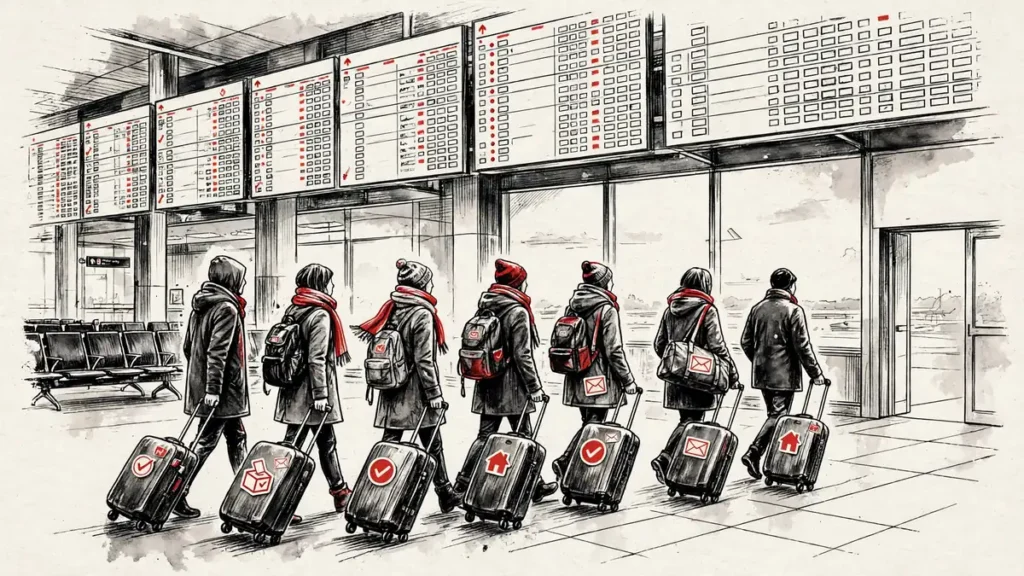
Most Israeli citizens living abroad cannot vote remotely. They must return to Israel and cast their ballots in person, with exceptions only for certain state employees working abroad and qualifying family members who may vote at diplomatic missions. That rule is why an election can produce an air-travel story at all: for overseas Israelis, voting means a flight home.
The figure of about 67,000 comes from the AID Coalition, a United States-based non-profit, and its Fly&Vote initiative. The Indian Express, citing an Associated Press report, said as many as 67,000 voters are returning, based on surveys and registration data gathered for Fly&Vote, with about half flying in from the United States and others from Europe, Canada, Australia and New Zealand. The Jerusalem Post reported the same estimate and added its basis: a voluntary survey of about 23,000 Israelis abroad, conducted from October 12 to 21, in which 79.6 percent of respondents said they intended to travel to vote.
Three caveats matter. First, 67,000 is an estimate of people intending to travel, not a verified count of people who have arrived. Second, the survey was voluntary and was not representative of all Israelis living abroad, and its published results do not report respondents’ party preferences. Third, it does not follow that these voters will vote one way: analysts quoted in the coverage note that many overseas Israelis are critical of Netanyahu, while others caution that expatriates are also travelling to vote for the pro-Netanyahu side, and that the overall effect on the result is uncertain.
A separate passenger figure sometimes quoted alongside the 67,000 should not be confused with it. Channel 13 figures cited by the Jerusalem Post put the difference between incoming and outgoing passengers in 2026 at more than 90,000, compared with about 77,000 in the same period in 2025. That is a passenger-flow gap, not a voter count: it includes children and foreign nationals who cannot vote, and it does not establish how many people returned specifically to vote. The Jerusalem Post’s comparison of the Fly&Vote estimate to roughly 1.7 Knesset seats, using about 40,000 votes per seat, is an arithmetic illustration, not a prediction of how those travellers will vote.
The mobilisation has itself become a campaign issue. The AID Coalition describes Fly&Vote as nonpartisan and says participants cover their own travel costs. Netanyahu’s Likud party appealed against the initiative and later withdrew the case after reaching an agreement, according to the reporting. AID Coalition president Jonathan Barsade was quoted as saying that, whatever their politics, participants view this election as critical.
What do the final polls say?
The final polls, published on October 23 by Israel’s three main television channels and summarised by Haaretz, tell a consistent story with different margins. Channel 12 projected the Eisenkot bloc at 56 seats against 50 for the Netanyahu bloc; Channel 13 put the blocs at 54 and 50; Kan public television put them at 52 and 50. In all three, Gadi Eisenkot’s Yashar party was the largest single party, with 22 or 23 seats, against 19 to 21 for Netanyahu’s Likud. Naftali Bennett and Yair Lapid’s Together party was third, with 14 or 15 seats.
The headline is the gap to 61. No poll projected either bloc winning a majority on its own. The Arab-majority parties were projected at 14 to 16 seats, and Haaretz noted that refusal to cooperate with the Arab parties leaves the Eisenkot-led bloc short of a majority even where it leads. That arithmetic is why the post-election period, not just polling day, will decide who governs: coalition negotiations could take weeks, and parties close to the 3.25 percent electoral threshold could decide the outcome by winning or losing representation.
By the numbers
| Metric | Figure | Source |
|---|---|---|
| Election date | October 27, 2026 | CONFIRMED – multiple outlets |
| Knesset seats / majority needed | 120 / 61 | CONFIRMED – multiple outlets |
| Overseas Israelis estimated travelling home to vote | About 67,000 | REPORTED – AID Coalition Fly&Vote estimate via AP / Jerusalem Post |
| Final-poll range, Eisenkot bloc | 52-56 seats | CONFIRMED – Haaretz summary of Kan, Channel 12, Channel 13 polls |
| Final-poll range, Netanyahu bloc | 50 seats | CONFIRMED – Haaretz summary of Kan, Channel 12, Channel 13 polls |
| Registered voters | More than 7.3 million | REPORTED – Indian Express / AP |
| Incoming-outgoing passenger gap, 2026 | More than 90,000 | REPORTED – Channel 13 figures via Jerusalem Post (passenger flow, not voters) |
Caveat: figures marked REPORTED rest on a single organiser estimate or a single outlet’s figures and should not be read as confirmed counts. The 67,000 figure is an estimate of intended travel, and the 90,000 figure counts passengers, not voters.
What the Israel election means for US, UK and EU readers
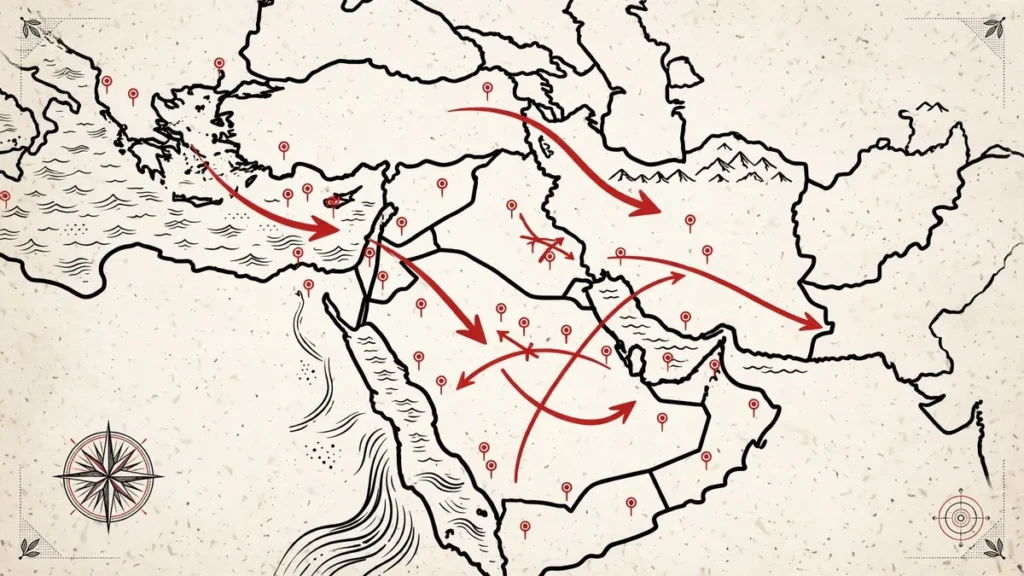
For readers in the United States, the United Kingdom and Europe, this election is not a spectator event. The next Israeli government will shape whether the February war with Iran stays closed or reopens, and that decision runs directly through Washington: the United States fought alongside Israel in February, Trump has now twice in two days publicly ruled out a strike on a given day, and Netanyahu’s final-week pitch is explicitly that he and Trump will “finish the job” together. A government led by Eisenkot would inherit the same Iranian file but without Netanyahu’s personal framing of it, and its first test would be whether it keeps, changes or seeks to close the confrontation.
For European readers, the stakes are travel, energy and diplomacy. A renewed Israel-Iran confrontation would again put Gulf shipping and airspace in the headlines, with the knock-on effects on fuel and flight routes that WarBrief has tracked through the Hormuz shipping standoff. For British and European Jewish communities and for the tens of thousands of Israelis living in the US, Europe, Canada and Australia, the election is also personal: many of them are the very voters now flying home, and the result will be read abroad as a verdict on the direction of a country whose politics now play out in diaspora living rooms as much as in Jerusalem.
None of that makes the result predictable. The polls point to a hung parliament, and a hung parliament means the next prime minister may be decided not on October 27 but in weeks of coalition bargaining, in which small parties and the Arab parties hold leverage neither main bloc can ignore.
Different perspectives
Netanyahu’s camp presents the warning as a security duty: a prime minister with intelligence signs of a possible disruption is obliged to warn the attacker off, and the threat of disproportionate blows is deterrence, not campaigning. His supporters point to the February war and to the Arrow battery backdrop as evidence that he is the candidate who has actually fought Iran.
His rivals present the same events as campaigning by other means. Eisenkot, at his final rally, warned that Netanyahu would stop at nothing to stay in power, according to Haaretz’s live coverage. Other opposition figures accuse Netanyahu of fearmongering and of using the Iranian threat to influence or delay the vote. Liberman’s call for a criminal investigation goes further, but it remains an opposition accusation, not a legal finding.
Iran’s position, as stated by Foreign Minister Abbas Araghchi on October 25 and reported by Firstpost, is that another round of fighting would not alter Tehran’s policies. That statement does not confirm or deny any Iranian intention toward the election; it is a diplomatic position, and it should be read as one. The White House’s reported alarm at the mushroom-cloud post, if accurate, adds a third perspective: that of an ally worried less about the election itself than about miscalculation in the days around it.
What to watch next in the Israel election
First, polling day itself: whether voting proceeds without a security incident, and whether turnout among overseas returnees is visible in the early turnout figures. Second, the exit polls on the night of October 27, which in past Israeli elections have moved as the count has proceeded, particularly for parties near the threshold. Third, the coalition arithmetic: whether Eisenkot can assemble 61 seats without the Arab parties, whether Netanyahu can hold his bloc together if Likud finishes second, and whether any small party’s failure to cross the threshold hands seats to its rivals. Fourth, the Iran file in the first week after the vote: whether the new government’s first statements harden or soften the confrontation, and whether Washington’s public “no strike today” pattern continues or ends. The official results are due on November 4, but the government may take far longer to form.
Frequently asked questions
When is the Israel election?
Israel votes on Tuesday, October 27, 2026, for all 120 members of the 26th Knesset. Results are due to be published on November 4, according to the official timetable, but coalition negotiations to form a government could take weeks after that.
What did Netanyahu warn about Iran and the election?
On October 25, Netanyahu said Israel had intelligence signs that Iran and its proxies could attack in order to disrupt the election, and he warned: “Don’t test us. You will suffer disproportionate blows.” He published no evidence, and no target, timing or method was disclosed, so the claim is reported as his assessment, not as a confirmed fact.
Can Israelis living abroad vote from overseas?
Most cannot. Israeli citizens living abroad generally must return to Israel and vote in person, with exceptions only for certain state employees abroad and qualifying family members. That is why the Fly&Vote initiative estimates about 67,000 overseas Israelis are travelling home to vote.
Who is leading in the polls?
Gadi Eisenkot’s Yashar party leads as the largest single party in the final polls, and his bloc leads Netanyahu’s bloc by two to six seats across the three main television polls. Neither bloc reaches the 61 seats needed for a majority, so the election is likely to produce a hung parliament and coalition talks.
Could the election be delayed by a security incident?
No delay has been announced, and the defence minister and the IDF have denied any intention to initiate an attack on Iran before the election. Netanyahu’s warning is about a possible Iranian or proxy attack to disrupt the vote; whether any such attack happens, and what it would mean for polling, remains unverified speculation at this stage.
Sources
- The Hindu: Netanyahu warns Iran may try to disrupt Israel election, says ‘don’t test us’
- The Times of Israel: Netanyahu claims Iran may try to disrupt election, warns, ‘Don’t test us’
- The Times of Israel: In ‘unprecedented confrontation,’ IDF chief said resisting Netanyahu’s order for military action tied to Iran
- News18: Netanyahu Warns Iran Against Election Interference, Threatens ‘Disproportionate Blows’
- Indian Express: Israel Election 2026: Thousands of Israelis Fly Home to Vote Against Netanyahu
- The Jerusalem Post: Israel Election: Israelis prioritize voting over vacations as election nears
- Haaretz: Last Polls Before Israel’s Election Put Eisenkot Ahead of Netanyahu as Both Lack Majority
- Firstpost: Netanyahu clashes with Israel’s army chief over reported Iran strike plan days before election
- Indian Express: Israel election 2026: Who is running and can Netanyahu survive biggest test of his political career?
- Haaretz: Israel Elections 2026 live coverage, October 26, 2026



Discussion 0
Share analysis, corrections, or context. Be civil — comments are moderated.