WarBrief Live | October 22, 2026 | Country Profile
Saudi Arabia’s military capabilities are facing their most severe live test in more than a decade. The kingdom is absorbing near-daily drone and missile strikes on its airports and oil facilities in October 2026 — a very different kind of war than the one its arsenals were built for.
Overview
Saudi Arabia is the Gulf’s dominant military power and the Middle East’s largest defense spender. The Stockholm International Peace Research Institute estimated its military expenditure at $80.3 billion in 2024, the seventh highest in the world. The Finance Ministry’s 2026 budget allocates SAR240 billion to the military sector. Global Firepower’s 2026 assessment credits the kingdom with roughly 247,000 active personnel, more than 900 total aircraft, over 1,000 tanks, and dozens of naval assets.
That wealth buys top-tier imported platforms. But the October 2026 escalation is exposing a central tension: an arsenal designed for state adversaries is being tested by a cheap, persistent campaign of drones and missiles launched by Yemen’s Iran-backed Houthis, with the four-year UN-brokered truce of April 2022 now broken.
Military capabilities
The kingdom’s strength is concentrated in its air force and air-defense network: Eurofighter Typhoon and F-15 fleets as core strike power, and a layered missile shield built on American systems. Washington approved a roughly $15 billion THAAD sale in 2017, a further $3 billion Patriot agreement followed in 2022, and another package worth around $9 billion was concluded in 2026. Four of seven planned THAAD sites were expected operational by end-2026, with South Korea’s KM-SAM Block II systems being integrated to diversify beyond US suppliers.
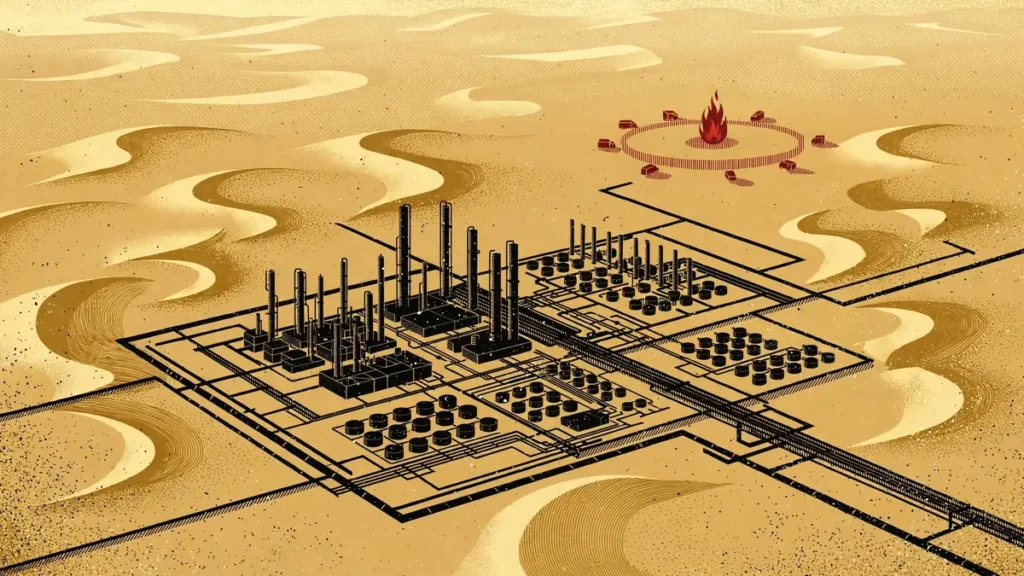
The weak point is low, slow, and cheap: drones. One audit found less than 2.4 percent of Saudi air-defense investment since 1990 went to counter-drone capabilities, though drones now make up an estimated 35–40 percent of actual threats. As Andreas Krieg of the London-based MENA Analytica firm put it, “even a layered system combining Patriot, THAAD, fighter aircraft and other sensors cannot create an impermeable dome over a country the size of Saudi Arabia” — roughly 2.2 million square kilometers of airports, pipelines, oil facilities, bases, and holy cities to defend continuously.
Alliances and posture
The United States remains Saudi Arabia’s central security partner — a bond now strained by the State Department’s October 21 order for non-emergency US government employees and their families to depart the kingdom. Riyadh is also deepening non-US ties: the Makkah Joint Defense Agreement, signed August 7, 2026, binds Pakistan, Saudi Arabia, and Türkiye in a decade-long mutual defense pact. Pakistan has ratified it; Türkiye has submitted it to parliament.
Egypt is the partner to watch. President Abdel-Fattah el-Sisi asked parliament on October 17 for authority to defend Saudi Arabia if requested; after adjourning debate on October 19, parliament votes on October 26. The constitution requires a two-thirds majority for overseas combat missions, and the opposition has instructed lawmakers to abstain over unclear objectives and costs. The financial stakes are visible: Saudi Arabia holds a $5.3 billion deposit at Egypt’s central bank, due this month. For more, see WarBrief’s Egypt military capabilities profile.
Current developments
October 2026 has been the kingdom’s deadliest month in over a decade. An October 10 strike on Riyadh’s King Khalid International Airport killed 12–13 people and injured more than 300, described in wire reporting as the deadliest attack in more than a decade; on October 13 a strike damaged a building at Saudi Aramco’s headquarters.
On the morning of October 21, air defenses intercepted a drone targeting Aramco’s Shaybah oil field; falling debris killed two people — Filipino and Nepali nationals — and injured a Pakistani and an Indian national, sparking a fire in a contractor’s vehicle. Operations were unaffected. That evening, an attack struck King Fahd International Airport in Dammam: civil aviation authorities first reported one killed and eight injured, then raised the toll on October 22 to two dead — a Saudi citizen and an Indian resident. Flights were diverted but later resumed; the Saudi-led coalition said it intercepted several drones launched toward the kingdom.
For the wider context of this campaign, see WarBrief’s coverage of the October 2026 Houthi offensive against Saudi Arabia.
Frequently asked questions
How strong is Saudi Arabia’s military?
Saudi Arabia is the Middle East’s largest defense spender — SIPRI estimated $80.3 billion in 2024, seventh worldwide — with roughly 247,000 active personnel, more than 900 aircraft, and over 1,000 tanks per Global Firepower’s 2026 assessment. Its strength lies in high-end imported platforms, especially airpower and US-built missile defenses.
Why can’t Saudi air defenses stop every Houthi drone?
Decades of investment went into Patriot and THAAD batteries built against aircraft and ballistic missiles, while cheap drones exploit lower-tier gaps. Defending 2.2 million square kilometers continuously means no layered system can intercept every projectile — and even successful interceptions rain dangerous debris.
Will Egypt send troops to help Saudi Arabia?
Egypt’s parliament votes on October 26, 2026, on authorizing military support if Saudi Arabia requests it. The constitution requires a two-thirds majority for overseas combat missions, and the opposition has instructed lawmakers to abstain over unclear objectives and costs — so the outcome is not yet certain.
Sources
- Reuters: Egypt delays vote on military support for Saudi Arabia until October 26
- Al Jazeera: US orders departure of personnel from Saudi Arabia, citing Houthi threat
- The Hindu: Saudi authorities say two killed by falling debris at oil facility following drone attack
- Daily Maverick: Two killed, 8 injured in attack on airport in Saudi oil city Dammam
- ProPakistani: Makkah Defense Pact binds Pakistan, Saudi Arabia, Turkiye for a decade
Related WarBrief coverage
- Country profiles hub
- Egypt Military Capabilities: What the Saudi Defense Pledge Reveals
- Yemen-Saudi Escalation: The October 2026 Houthi Offensive