
WarBrief Live | October 16, 2026 | Cybersecurity
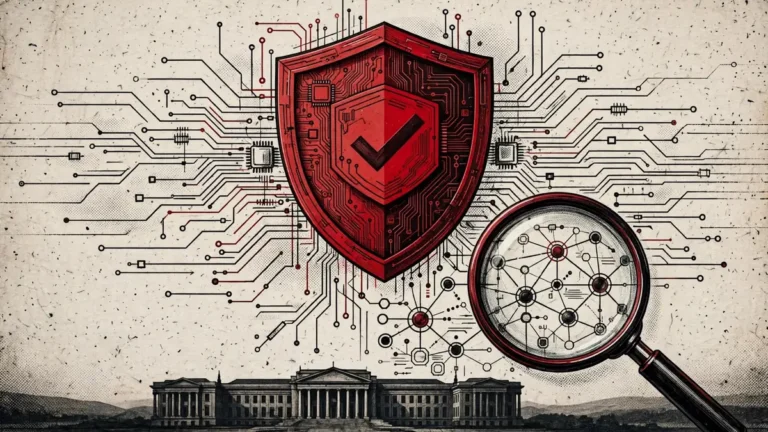
Threat intelligence services for government agencies sit at the center of one of cybersecurity’s quietest markets: the machinery that tells public-sector defenders what is coming for them. On September 30, 2026, WaterISAC — the information-sharing hub for the American water sector — partnered with the threat-intelligence firm Cyware to give U.S. water and wastewater utilities real-time, AI-powered threat feeds. The deal is a window into how government threat intelligence actually works: a mix of federal programs, sector sharing hubs, and commercial vendors competing for public-sector buyers.
This guide maps that landscape for the people who buy, use, or oversee government threat intelligence: what the services are, how agencies use them, who the main vendors are, how sharing ecosystems like ISACs and CISA’s Automated Indicator Sharing fit in, and how public-sector teams should evaluate a service.
Key Takeaways
- Government threat intelligence is a three-layer system: free federal feeds (CISA AIS, the Known Exploited Vulnerabilities catalog), sector sharing hubs (ISACs/ISAOs), and commercial vendor platforms.
- The September 30, 2026 WaterISAC–Cyware partnership shows the current trend: sector ISACs buying commercial platforms to automate collection and distribution of threat data to utilities of all sizes.
- Major vendors serving the public sector include Recorded Future, Mandiant, CrowdStrike, Flashpoint, Cyware, and Red Sky Alliance — the last reaching agencies through Carahsoft’s government contract vehicles since April 2026.
- For government buyers, the decisive evaluation criteria are STIX/TAXII interoperability, analyst workflow integration, sharing-ecosystem compatibility, and procurement through authorized contract vehicles.
What Are Threat Intelligence Services for Government?
A threat intelligence service collects, analyzes, and distributes information about cyber threats — indicators of compromise such as malicious IP addresses and file hashes, tactics and techniques of known adversary groups, vulnerability exploitation trends, and strategic assessments of who is targeting what. For government agencies, these services serve a dual purpose: they feed operational defenses (firewalls, endpoint tools, security operations centers) and they inform decisions (which threats to prioritize, which sectors are being targeted, where to allocate defensive resources).
The government market differs from the corporate market in several ways. Procurement runs through authorized vehicles — GSA schedules, NASA SEWP, state purchasing cooperatives — rather than direct sales. Classification and handling rules shape what can be shared and with whom. And government buyers are typically both consumers and producers of intelligence: a state agency that receives a federal alert about ransomware targeting utilities is also expected to report back what it finds, feeding the same sharing ecosystems it draws from.
Commercial services generally come in three forms. Threat intelligence platforms aggregate feeds, correlate indicators, and provide analyst workbenches. Intelligence feeds deliver machine-readable indicators for automated ingestion into security tools. Analyst services provide finished reporting — written assessments of adversary campaigns and their implications. Most vendors bundle all three.
” alt=”Threat intelligence services for government agencies: editorial illustration of interlocking shields exchanging data streams over a water utility plant” width=”1200″ />
How Do Government Agencies Use Threat Intelligence?
Federal agencies use threat intelligence across the full defensive cycle. The Cybersecurity and Infrastructure Security Agency (CISA) pushes machine-readable indicators through its Automated Indicator Sharing (AIS) service, a TAXII 2.1 server that exchanges STIX-formatted cyber threat indicators and defensive measures with vetted partners. The AIS community spans private-sector entities, federal departments and agencies, state, local, tribal, and territorial governments, ISACs and ISAOs. Alongside AIS, CISA publishes the Known Exploited Vulnerabilities (KEV) catalog — the authoritative list of vulnerabilities confirmed to be exploited in the wild, which federal civilian agencies must remediate under Binding Operational Directive 22-01.
State and local governments are heavier consumers than producers. Fusion centers — state-owned hubs that bring together law enforcement and other partners — serve as distribution points for federal threat reporting. Recent federal planning has identified fusion centers and state and local election officials as key channels for threat intelligence ahead of the 2026 midterms, with threat reporting flowing through fusion centers in coordination with the FBI and DHS’s Office of Intelligence and Analysis.
Sector-specific agencies and utilities rely on ISACs. WaterISAC’s partnership with Cyware is the clearest recent example of why: the water sector includes thousands of small utilities with minimal security staff, so the ISAC acts as a collective analyst — collecting threat and vulnerability information, validating it, and distributing it in forms members can act on. Its existing partnership with the National Rural Water Association extends cybersecurity resources to more than 20,000 smaller water utilities.
Which Vendors and Platforms Serve the Public Sector?
The vendor landscape serving government buyers clusters around a handful of established names, plus newer entrants built specifically for collective defense:
- Recorded Future — one of the largest commercial threat-intelligence providers, correlating relationships across a claimed million-plus global sources through its Intelligence Graph; widely used by federal agencies.
- Mandiant (Google Cloud) — known for incident-response-backed intelligence on APT groups and nation-state actors, a natural fit for government buyers tracking state-sponsored campaigns.
- CrowdStrike — integrates adversary profiles and malware analysis into endpoint security workflows, common in agencies that standardize on its platform.
- Flashpoint — specializes in deep and dark web intelligence and human intelligence sources.
- Cyware — an agentic AI-powered operational threat-intelligence and collective-defense platform; its September 2026 WaterISAC partnership is its highest-profile public-sector deployment this year.
- Red Sky Alliance — delivers targeted threat intelligence (REDXRAY daily cyber threat scores, Cyber Threat Analysis Center) to public-sector buyers through Carahsoft’s Master Government Aggregator channel, under an April 16, 2026 partnership covering NASA SEWP V, ITES-SW2, NASPO ValuePoint, and OMNIA Partners vehicles.
- Cisco Talos and IBM X-Force Exchange — large commercial intelligence teams and sharing platforms that underpin many government deployments.
A recurring pattern is the aggregator channel: vendors like Red Sky Alliance reach agencies not through direct sales but through distributors such as Carahsoft that hold the contract vehicles. For buyers, this means the practical question is often not “which vendor?” but “which vendors are on the vehicles my agency can buy from?”
How Does Threat Intelligence Sharing Work? ISACs, ISAOs and Federal Programs
The sharing layer is what makes government threat intelligence distinctive. Information Sharing and Analysis Centers (ISACs) are sector-specific nonprofits that pool threat data among members: FS-ISAC for finance, Health-ISAC for healthcare, WaterISAC for water, the Elections Infrastructure ISAC for election officials, and others. Information Sharing and Analysis Organizations (ISAOs) play a similar role for looser communities. The FBI’s InfraGard program provides a public-private partnership channel for critical-infrastructure protection.
At the federal level, CISA operates the sharing infrastructure: AIS for machine-readable exchange, the KEV catalog for exploited vulnerabilities, published Cybersecurity Advisories, and CSAF-format advisories. CISA’s information-sharing programs are explicitly designed so that “with the right plans, processes, and connections in place, information sharing can be a seamless step of incident response procedures.”
The WaterISAC–Cyware partnership illustrates how the layers combine: a sector ISAC licensing a commercial platform to automate collection, analysis, and distribution, reducing manual work so validated threat and vulnerability information reaches members faster. WaterISAC executive director Tom Dobbins described the goal as giving analysts a platform that “helps our analysts deliver more real-time insights to our members and lets us extend that directly to our larger utilities.” Cyware’s Tom Stockmeyer framed the same idea as collective defense: a detected threat should reach every participating organization “regardless of size or cyber maturity.” The same pattern applies to other sectors hunting for ways to serve small, under-resourced members.
” alt=”Threat intelligence services for government agencies: editorial illustration of a balance scale weighing an analyst radar eye against threat intelligence reports” width=”1200″ />
How Should a Government Team Evaluate a Threat Intelligence Service?
Public-sector buyers should evaluate vendors against criteria shaped by how government actually consumes intelligence:
- Standards interoperability. Does it ingest and export STIX/TAXII natively, so indicators flow into existing tools and up to AIS without manual reformatting?
- Analyst workflow fit. Can a small team — sometimes a single analyst covering multiple departments — triage, enrich, and act on the feed without a full-time integration project?
- Intelligence levels. Does it deliver tactical indicators (IPs, hashes), operational context (campaign tracking), and strategic assessments (who is targeting your sector and why)?
- Sharing-ecosystem compatibility. Can finished intelligence be pushed to the agency’s ISAC, fusion center, or federal partners under appropriate handling rules?
- Procurement path. Is the vendor on a vehicle the agency can actually buy through — SEWP, ITES, state cooperatives — and does it meet FedRAMP or agency authorization requirements?
- Sector relevance. Generic feeds miss sector-specific threats; a water utility needs OT and ICS intelligence, a state election office needs influence-operation coverage.
Background and Timeline: From Fax Trees to Machine-Readable Intel
Government threat-intelligence sharing has matured through distinct eras:
- 1998 — Presidential Decision Directive 63 encourages sector ISACs; the first sharing hubs form.
- 2015 — The Cybersecurity Information Sharing Act (CISA 2015) provides liability protections for sharing cyber threat indicators with DHS and the federal government.
- 2016 — CISA’s Automated Indicator Sharing (AIS) goes live, enabling real-time machine-readable exchange.
- 2018 — CISA is established as the federal civilian cybersecurity agency, consolidating federal sharing programs.
- 2021 — Binding Operational Directive 22-01 makes KEV-catalog remediation mandatory for federal civilian agencies.
- April 2026 — Red Sky Alliance partners with Carahsoft, bringing targeted threat intelligence to the public sector through major government contract vehicles.
- September 30, 2026 — WaterISAC partners with Cyware for real-time, AI-powered threat intelligence for U.S. water and wastewater utilities.
What This Means for US, UK and EU Readers
For American readers, the practical takeaway is that government threat intelligence is increasingly something agencies buy, not just something they receive. The federal free layer (AIS, KEV, advisories) remains the foundation, but the operational work — correlation, enrichment, distribution to small members — is moving to commercial platforms inside ISACs. If you run a utility, a municipal government, or a state agency, your ISAC membership and its platform choices determine what intelligence actually reaches your team. WarBrief’s Censys vs Shodan comparison for threat hunting teams covers the open-source side of the same problem: how defenders find exposed infrastructure before attackers do.
For UK and EU readers, the architecture differs — the UK’s National Cyber Security Centre and EU bodies like ENISA play the CISA role — but the commercial vendor landscape is largely the same, and the ISAC model has European equivalents. The WaterISAC precedent is worth watching: sector sharing hubs everywhere face the same challenge of serving under-resourced members, and commercial collective-defense platforms are the current answer. For the intelligence-analysis craft behind these feeds, see WarBrief’s guide to investigating cyber attacks with internet intelligence and how analysts track adversary infrastructure, plus the WarBrief tools desk.
What to Watch Next
Three trends will shape government threat intelligence in 2027. First, AI-driven correlation inside ISAC platforms — the Cyware model of “agentic” operational intelligence — will spread to other sectors as sharing hubs look to automate manual analyst work. Second, procurement consolidation: as vendors bundle platforms, feeds, and analyst services, agencies will increasingly buy intelligence through aggregators and contract vehicles rather than evaluating standalone feeds. Third, the CISA relationship: with the agency’s state-and-local ties under strain in 2026, per recent reporting, the balance between federal programs and sector-led sharing will be renegotiated — and the ISACs’ commercial platform investments are a hedge against that uncertainty.
| Metric | Figure | Source |
|---|---|---|
| WaterISAC–Cyware partnership announced | September 30, 2026 | PR Newswire (Cyware announcement) |
| Smaller utilities reached via WaterISAC–NRWA partnership | More than 20,000 | Underground Infrastructure, September 30, 2026 |
| Red Sky Alliance–Carahsoft partnership announced | April 16, 2026 | GlobeNewswire (Carahsoft) |
| CISA AIS exchange format | STIX indicators over TAXII 2.1 | CISA information-sharing documentation |
| Federal KEV remediation mandate | Binding Operational Directive 22-01 | CISA |
Caveat: dates and partnership details are confirmed from the named sources. Vendor capability descriptions reflect public product positioning as of October 2026; the vendor landscape changes quickly and should be re-verified at purchase time. No pricing figures are given because commercial TI pricing is quote-based and was not verifiable from public sources.
Frequently asked questions
What are threat intelligence services for government agencies?
They are commercial or federally provided services that collect, analyze, and distribute information about cyber threats — malicious indicators, adversary tactics, vulnerability trends — tailored for public-sector defenders. They include intelligence platforms, machine-readable feeds, and analyst reporting, and they complement free federal programs like CISA’s Automated Indicator Sharing.
How do state and local governments get threat intelligence?
Through several channels: CISA’s AIS and published advisories, fusion centers that distribute federal threat reporting, sector ISACs (like WaterISAC) that share validated sector-specific intelligence, and commercial vendors purchased through government contract vehicles. Many smaller agencies rely on their ISAC as their primary intelligence source.
What is CISA Automated Indicator Sharing (AIS)?
AIS is a CISA service enabling real-time exchange of machine-readable cyber threat indicators and defensive measures between public- and private-sector organizations, using the STIX format over a TAXII 2.1 server. Participants — including federal agencies, SLTT governments, and ISACs — connect with a STIX/TAXII capability to exchange indicators under a Terms of Use agreement.
How should a government agency choose a threat intelligence vendor?
Evaluate STIX/TAXII interoperability, fit with the analyst team’s workflow, coverage across tactical, operational, and strategic intelligence levels, compatibility with the agency’s ISAC and federal sharing obligations, availability on an authorized procurement vehicle, and sector-specific relevance (OT intelligence for utilities, influence-operation coverage for election offices).
Is government threat intelligence free?
Partly. CISA’s AIS, the KEV catalog, and published advisories are free, and ISAC membership provides sector intelligence — but commercial platforms, premium feeds, and analyst services are paid, typically through quote-based contracts on government purchasing vehicles. The trend, exemplified by the WaterISAC–Cyware deal, is sector hubs licensing commercial platforms to automate distribution.
Related reading
- GEOINT Platforms Compared: 2026 Defense Buyer’s Guide
- EASM Tools Compared: Best External Attack Surface (2026)
Sources
- Route Fifty: New partnership formed to share cyber threat intel with water utilities
- PR Newswire: Cyware and WaterISAC join forces to strengthen water sector cyber defense
- GlobeNewswire: Red Sky Alliance and Carahsoft partner to deliver cyber threat intelligence to the public sector
- CISA: Information sharing programs
- Underground Infrastructure: WaterISAC taps Cyware to strengthen water utility cyber defense
Discussion 0
Share analysis, corrections, or context. Be civil — comments are moderated.