WarBrief Live | November 6, 2026 | Conflict Zones
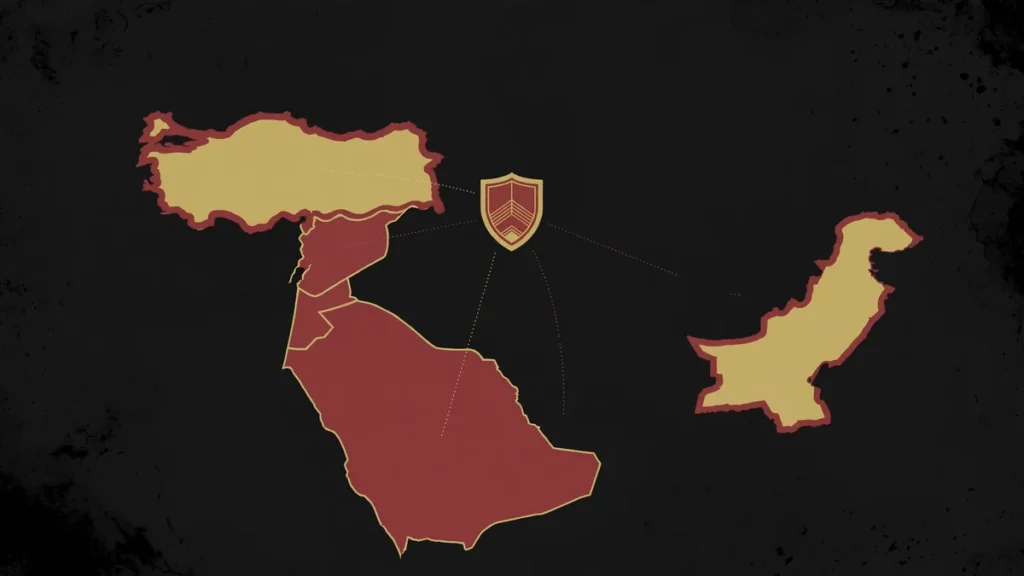
Syria is weighing whether to join the Mecca defence pact, the mutual-defence alliance signed in August 2026 by Saudi Arabia, Turkiye and Pakistan. Foreign Minister Asaad al-Shaibani said on October 31 that Damascus is “evaluating” entry, a move that would anchor the post-Assad government in the region’s newest security bloc.
Key Takeaways
- Syria is evaluating entry into the Mecca defence pact; it has not joined and no decision has been announced.
- On November 4, Damascus signed a defence deal with Riyadh, plus $403 million in Saudi loans.
- Turkiye ratified the pact on November 5 by 279 votes to 119.
- Damascus frames it around deterrence: al-Shaibani says Israel has carried out more than 1,000 attacks on Syria in under two years.
What is the Mecca defence pact?
The Mecca Joint Defence Agreement was signed on August 7, 2026, in Mecca by Saudi Crown Prince Mohammed bin Salman, Turkish President Recep Tayyip Erdogan and Pakistani Prime Minister Shehbaz Sharif. Its 16 articles commit the three states to treat an armed attack on one as an attack on all three, and to deepen military cooperation and intelligence sharing. It has been compared to NATO’s collective-defence principle, though it is much younger and untested.
On November 5, Turkiye’s parliament ratified the agreement by 279 votes to 119. The pact runs for ten years. Ratification does not by itself authorise troop deployments abroad: under Turkiye’s constitution, any deployment would need a separate parliamentary mandate.
Who are the key actors in Syria’s decision?
President Ahmed al-Sharaa leads the government that came to power after Bashar al-Assad fell in December 2024. His government is rebuilding the state amid repeated Israeli strikes and foreign forces on Syrian soil. In a September speech, al-Sharaa said Syria aimed to end all foreign military bases in the country.
Foreign Minister Asaad al-Shaibani is the public face of the pact question. At the Manama Dialogue in Bahrain on October 31, he said “discussions are currently under way to evaluate Syria’s entry into the Mecca alliance.” Saudi Arabia is Syria’s key backer and the pact’s driving force, assembling regional support as Riyadh faces sustained Houthi attacks. Israel is the other side of the deterrence equation: al-Shaibani said Israel has carried out more than 1,000 attacks on Syria in less than two years, killing dozens of people.
What has happened since October 31?
- October 31, 2026: At the Manama Dialogue, al-Shaibani says Syria is evaluating entry into the Mecca alliance and says the region is “in greater need than ever” of joint deterrence.
- November 4, 2026: President al-Sharaa visits Riyadh, his second trip in under a month, and meets Crown Prince Mohammed bin Salman. The two defence ministries sign a cooperation agreement, terms undisclosed, and the Saudi Fund for Development agrees to provide more than $403 million in concessional loans.
- November 5, 2026: Turkiye’s parliament ratifies the Mecca pact by 279 votes to 119. Reuters had previously reported Damascus was considering assisting Saudi Arabia against the Houthis, a claim that remains reported rather than confirmed.
Where does Syria stand now?
Damascus is in the evaluation phase, not the accession phase. The November 4 deal with Riyadh is a bilateral agreement between two defence ministries, not pact membership, and its terms have not been published. The loans are concrete: $100 million for healthcare, $60 million for housing, $105 million for civil defence, $90 million for the Aleppo thermal power plant and $30 million for drinking water in Damascus and Idlib, according to the Saudi Press Agency.
Qatar and Kuwait are named as other possible candidates, but Damascus is the first to say so publicly, making its decision the pact’s first expansion test. Our July Syria profile covers the force posture Damascus inherited; this entry replaces it as the current reference.
What would joining mean for Syria’s security?
Joining would give Damascus a mutual-defence guarantee from three states and formalise Saudi backing already flowing in loans and defence cooperation. The risks are clear: membership would tie Syria to the Saudi-Houthi war, complicate al-Sharaa’s aim of ending foreign military bases, and rest on a pact whose collective-defence clause no member has yet invoked.
What to watch next in Damascus and Riyadh
- Whether Damascus moves from “evaluating” to a formal decision.
- Whether the terms of the Syrian-Saudi defence deal are published, and whether they cover Yemen.
- Whether Saudi and Pakistani ratifications follow Turkiye’s, bringing the pact into force.
Frequently asked questions
Has Syria joined the Mecca defence pact?
No. Foreign Minister Asaad al-Shaibani said on October 31 that Damascus is evaluating entry. No decision has been announced.
What is the Mecca defence pact?
The Mecca Joint Defence Agreement, signed on August 7, 2026, by Saudi Arabia, Turkiye and Pakistan, treats an armed attack on one member as an attack on all three. Turkiye ratified it on November 5, 2026, by 279 votes to 119.
Why is Syria considering joining?
Damascus frames it around deterrence: al-Shaibani says Israel has carried out more than 1,000 attacks on Syria in under two years.
Sources
- Al Jazeera: Syria considering entry into Mecca defence pact
- Al Jazeera: Syria, Saudi Arabia sign defence deal and $403m loans
- Breaking Defense: Syria weighs joining the Mecca Pact
- TRT World: Turkiye’s parliament ratifies Mecca Joint Defence Pact
- Straits Times: Saudi, Syrian defence ministries sign deal
See the Conflict Zones hub for all of WarBrief’s conflict profiles.