WarBrief Live | November 5, 2026 | Conflict Zones
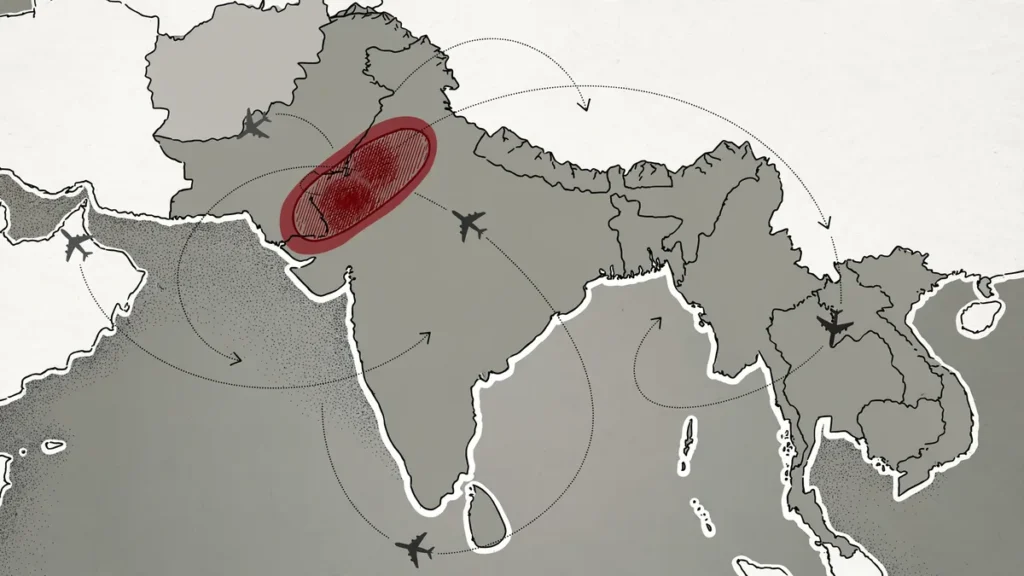
Pakistan has extended its ban on Indian aircraft until November 24, 2026, keeping the skies between the two nuclear-armed neighbours shut for an eighteenth month. The Kashmir airspace ban, first imposed after the Pahalgam attack in April 2025, has outlived the ceasefire that ended the fighting — and neither side has signalled when it might lift.
Key Takeaways
- Pakistan’s Notice to Airmen A0590/26, issued October 17, keeps Indian-registered, owned, operated or leased aircraft — including military flights — out of Pakistani airspace until 04:59 PKT on November 24, 2026.
- The restrictions date to the Pahalgam attack of April 22, 2025, which killed 26 people, and survived the US-announced ceasefire of May 10, 2025.
- India’s reciprocal ban on Pakistani airlines, imposed April 30, 2025, remains in force.
- Air India is shifting some westbound operations from Delhi to Mumbai as the detours add flight time, fuel burn and cost.
Overview: A Frozen Front, 18 Months On
Kashmir is divided by the Line of Control (LoC), the heavily militarised de facto border between Indian-administered and Pakistan-administered territory. A ceasefire along the LoC has held in name since 2003, but the political dispute behind it is unresolved, and the region has produced three wars and repeated crises between the two states.
The current standoff began with the Pahalgam attack on April 22, 2025, when gunmen killed 26 people in Indian-administered Kashmir. India attributed the attack to Pakistan-linked militant networks, a claim Pakistan denied. Within days, both governments had closed their airspace to each other’s aircraft — and those closures have now been renewed month after month for a year and a half, even though the shooting war ended in May 2025.
Key Actors in the Kashmir Standoff
India closed its airspace to Pakistani airlines on April 30, 2025, and has kept the reciprocal ban in force since. Its carriers, above all Air India, absorb the largest costs from the detours.
Pakistan controls the airspace Indian carriers need for the shortest westbound routes. The Pakistan Airports Authority (PAA) issues the monthly Notices to Airmen that keep the ban in force, and Islamabad has given no indication it will let the current notice lapse. Pakistan’s domestic security pressures, including the TTP and Balochistan insurgencies, run in parallel to the standoff.
The United States mediated the May 2025 ceasefire, with President Donald Trump announcing the agreement and Secretary of State Marco Rubio and Vice President JD Vance in contact with both prime ministers.
Airlines and aviation authorities on both sides manage the practical consequences: longer routings, higher fuel burn, revised crew schedules and shifting hub operations.
Recent Developments in the Kashmir Airspace Standoff
- April 22, 2025: Gunmen kill 26 people in Pahalgam, Indian-administered Kashmir. India attributes the attack to Pakistan-linked networks; Pakistan denies involvement.
- April 23, 2025: Pakistan closes its airspace to Indian aircraft.
- April 30, 2025: India closes its airspace to Pakistani airlines in response.
- May 7, 2025: India launches strikes inside Pakistan under Operation Sindoor, describing them as aimed at terrorist infrastructure; Pakistan reports civilian deaths. Cross-border shelling follows along the LoC.
- May 10, 2025: The United States announces a ceasefire, with both sides agreeing to stop all firing and military action from 17:00 IST. Explosions are reported in Srinagar hours later, and each side blames the other for violations.
- October 17, 2026: The PAA issues NOTAM A0590/26, replacing A0521/26 and extending the ban until 04:59 PKT on November 24, 2026. The notice covers the Karachi and Lahore flight information regions, from ground level to unlimited altitude.
- November 3, 2026: Air India says it is shifting some westbound operations from Delhi to Mumbai, saying the restrictions have raised operating costs and contributed to its losses. Delhi has been more affected than Mumbai, particularly on routes to Europe and North America.
Current Status: Bans in Force, No Talks Announced
As of November 5, 2026, the reciprocal airspace bans remain fully in force. Pakistan’s notice bars Indian-registered aircraft and aircraft owned, operated or leased by Indian airlines or operators, explicitly including military flights. India’s ban on Pakistani airlines likewise continues. Neither government has signalled any negotiation toward lifting the restrictions, and no timeline for normalisation has been put on the table.
The cost falls unevenly. Indian carriers flying west from northern India must route around Pakistan, adding flight time reported at tens of minutes to two or three hours on some longer services, with reported fuel consumption increases of up to about 29 percent on some Air India long-haul routes. Air India’s reported projection of roughly $600 million in additional annual costs illustrates the scale, though that figure is the airline’s own estimate rather than an audited total.
The military significance of the notice should not be overstated. The inclusion of military flights preserves a declared denial of routine access, but the notice itself contains no evidence of additional deployments, changed readiness or preparations for a renewed exchange. The extension is an administrative renewal, not a new battlefield event.
What to Watch Before the November 24 Deadline
The next decision point is the expiry of NOTAM A0590/26 at 04:59 PKT on November 24, 2026. The pattern of the past 18 months is monthly renewal, announced roughly a week before expiry, so watch for a fresh notice around November 17. An expiry allowed to pass without renewal would be the first real sign of a thaw.
Also watch for any diplomatic signal from either capital and for further Air India network changes, which would show whether the airline expects the closure to persist into 2027. And watch the LoC itself: the May 2025 ceasefire has held in broad terms, but the violations reported on its first night are a reminder that the line can flare with little warning.
Frequently asked questions
Why is Pakistan’s airspace closed to Indian aircraft?
Pakistan closed its airspace to Indian aircraft on April 23, 2025, a day after the Pahalgam attack in Indian-administered Kashmir killed 26 people. India attributed the attack to Pakistan-linked networks, which Pakistan denied. The ban has been extended monthly ever since, most recently to November 24, 2026.
Does the ban apply to military flights?
Yes. The current notice, A0590/26, explicitly covers military flights alongside civilian aircraft, and applies across both the Karachi and Lahore flight information regions, from ground level to unlimited altitude.
How much is the airspace closure costing Air India?
Air India has reported a projection of roughly $600 million in additional annual costs from the restrictions, and reported fuel consumption increases of up to about 29 percent on some long-haul routes. Both figures are reported estimates, not audited totals, and the impact varies by route.
When will the ban end?
The current notice expires at 04:59 PKT on November 24, 2026. Based on the pattern of the past 18 months, a further extension is the likelier outcome unless either government signals otherwise, but the expiry date is the first moment a change could take effect.
Sources
- Defence Security Asia: Pakistan Extends Indian Aircraft Ban to November 24
- Gulf News: Pakistan Extends Airspace Ban on Indian Aircraft Until November 24
- CNBC-TV18: Air India Shifts Westbound Flights From Delhi to Mumbai
- NPR: Trump Says the U.S. Helped Broker Ceasefire Between India and Pakistan