WarBrief Live | October 30, 2026 | Conflict Zones
The South China Sea dispute hardened into its sharpest diplomatic standoff of the year in Cebu this week, as Australia’s defence chief accused China of creating a “condition of pressure” across Southeast Asia and the four-nation “Squad” pledged deeper military coordination. The 20th ASEAN Defence Ministers’ Meeting (ADMM) and the 13th ADMM-Plus, held in Lapu-Lapu City, Cebu, on October 28-29, 2026, ended with a joint declaration reaffirming international law in the disputed waters — and with China represented only by its Manila-based defence attaché after a public row over its participation. WarBrief’s ADMM-Plus in Cebu report covered the meeting itself; this profile assesses what it means for the sea dispute.
Key Takeaways
- Australian Defence Minister Richard Marles called China’s buildup the biggest conventional military expansion since World War II, creating a “condition of pressure” in Southeast Asia.
- The Squad — the United States, Japan, Australia and the Philippines — met on October 28 and committed to greater defence policy coordination.
- Manila said China’s military and coast guard presence in contested areas nearly doubled in September 2026.
- The Manila Declaration reaffirmed UNCLOS, freedom of navigation and overflight, and self-restraint in the disputed waters.
Overview: a sea at the centre of the region’s rivalry
The South China Sea, tracked in WarBrief’s conflict zones coverage, is one of the world’s busiest shipping lanes, with overlapping claims by China, the Philippines, Vietnam, Malaysia, Brunei and Taiwan. China claims almost the entire waterway, a position an international arbitral tribunal ruled in 2016 has no legal basis — a ruling Beijing rejects. The Philippines, which holds the ASEAN chair in 2026, has pushed the dispute to the top of the regional agenda, while China has expanded coast guard patrols, built up artificial islands and increased naval activity in contested areas.
What changed in Cebu is the language and the company. Marles’s “condition of pressure” framing, delivered on October 29, was the bluntest public assessment of China’s buildup by an Australian defence chief at a regional forum, and it came hours after the Squad’s ministers met in person. ASEAN’s own declaration stuck to its familiar formula — peace, international law and self-restraint, without naming China. The gap between those two registers is the dispute in miniature.
Key actors in the South China Sea dispute
China deploys hundreds of coast guard, navy and other vessels to patrol disputed areas, according to reporting from Cebu. Beijing says its activities are lawful and accuses Manila of abusing its ASEAN chairmanship; its defence ministry said on October 29 that China had sent only its defence attaché in the Philippines, Senior Captain Yang Lei, to the meeting.
The Philippines, profiled in WarBrief’s Philippines country profile, chaired both meetings through Defence Secretary Gilberto Teodoro Jr. Manila rejected Beijing’s claim that its participation was obstructed, saying China received an invitation and ample opportunity to present its position. Teodoro also defended the Philippines’ defence arrangements with outside partners, including hosting the Typhon missile system, as an internal matter.
The Squad — the United States, Japan, Australia and the Philippines — is an informal defence grouping, not a treaty alliance. US Secretary of War Pete Hegseth, Japan’s Defence Minister Shinjiro Koizumi, Marles and Teodoro met on October 28, their first meeting in this format since November 1, 2025, in Malaysia. Hegseth said the four countries were moving “beyond words to practical cooperation” along the First Island Chain, the archipelago line running from Japan through Taiwan to the Philippines.
ASEAN as a bloc remains the forum where the dispute is managed, not settled. The ADMM-Plus brings together ASEAN’s ten members and eight dialogue partners, and its consensus rule means joint texts are restrained — analysts quoted ahead of the meeting expected the chairman’s statement to be more restrained than the closed-door talks.
Recent developments: what happened in and around Cebu
- July 2026: Australia protests China’s test of a nuclear-capable missile in the South Pacific, calling the launch destabilising, according to Agence France-Presse reporting from Cebu.
- Early October 2026: Manila says China’s military and coast guard presence in contested areas nearly doubled in September.
- October 27, 2026: The Philippine military says it monitored and shadowed China’s Liaoning aircraft carrier group as it passed through waters off the southern Philippines toward the Celebes Sea.
- October 28, 2026: The 20th ADMM and 13th ADMM-Plus open in Cebu under the theme “Navigating Our Future, Together.” The Squad defence ministers meet on the sidelines.
- October 29, 2026: Marles tells reporters China is undertaking “the biggest conventional military build-up that the world has seen since the end of the Second World War” and offers no explanation for it. The ADMM adopts five new cooperation initiatives and the Manila Declaration, and the Philippines hands the ADMM chairship to Singapore.
Current status: two tracks, one dispute
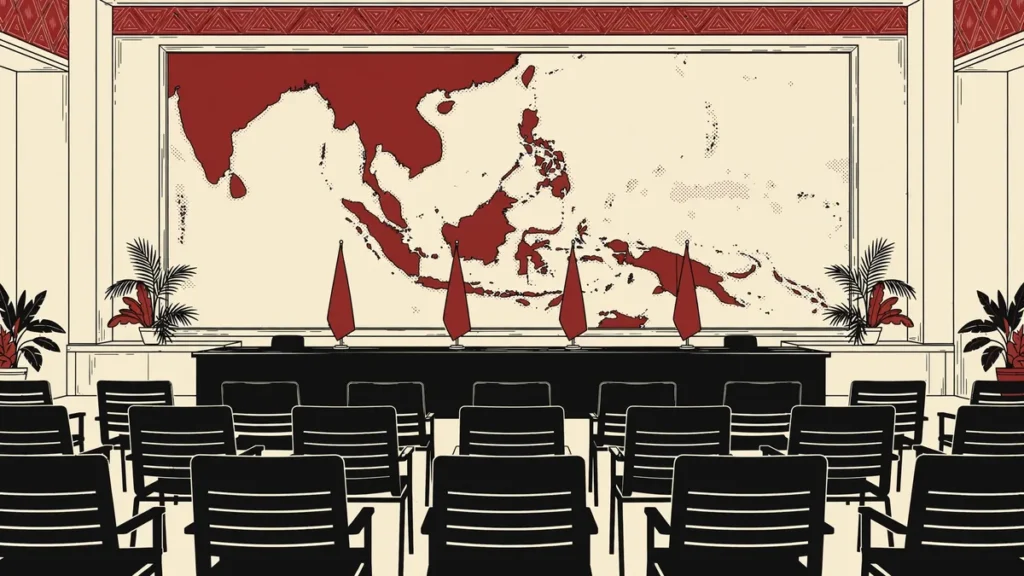
On the ASEAN track, the Manila Declaration reaffirmed peace and stability in accordance with international law, particularly the UN Charter and the 1982 UN Convention on the Law of the Sea (UNCLOS). It called for full implementation of the 2002 Declaration on the Conduct of Parties (DOC), early conclusion of an effective and substantive Code of Conduct (COC), freedom of navigation and overflight, and self-restraint in activities that could escalate disputes. The five initiatives adopted alongside it are practical: youth leader exchanges, resilience against chemical, biological and radiological threats, closer ADMM-Plus and ASEAN Regional Forum synergy, a guide to ADMM practices, and a maritime security conference with India in 2027.
On the Squad track, the October 28 meeting produced no joint statement and no specific new commitments. What it did produce was a commitment to greater defence policy coordination — policy consultations, joint exercises and coordinated infrastructure investment in the Philippines — and a signal that the four countries intend to keep meeting as a group. Marles noted the program is expanding: next year’s Alon exercise between Australia and the Philippines will involve hundreds of US personnel, with Japan previously an observer. Beijing’s response points the other way: Chinese state-linked commentary dismissed Marles’s claims as unsubstantiated and accused Australia of using the buildup narrative to legitimise its own expansion, including the AUKUS submarine program.
What to watch in the South China Sea
First, whether the Squad’s coordination produces concrete announcements — joint patrols, exercises or equipment transfers — or stays at policy consultation; the Alon exercise in 2027 is the first dated test. Second, whether China’s patrol tempo stays at the elevated September level or eases after the Cebu spotlight; Manila’s monthly monitoring reports are the public record to follow. Third, whether the Code of Conduct negotiations show movement under Singapore’s ADMM chairship. Finally, any further carrier-group transits or coast guard incidents near Philippine-held features, historically the trigger for the next diplomatic round.
Frequently asked questions
What is the “condition of pressure” in the South China Sea?
It is Australian Defence Minister Richard Marles’s phrase, used in Cebu on October 29, 2026, for the effect he says China’s military buildup is having on Southeast Asia. He linked it to what he called the biggest conventional military buildup since World War II and said Beijing offers no explanation for it.
What is the Squad?
The Squad is an informal defence and security grouping of the United States, Japan, Australia and the Philippines. Its defence ministers met on the sidelines of the ADMM-Plus in Cebu on October 28, 2026, and committed to greater defence policy coordination. It is a dialogue format, not a treaty alliance.
What did the Manila Declaration say about the South China Sea?
Adopted at the 20th ADMM in Cebu, the Manila Declaration reaffirmed peace and stability in accordance with international law, including UNCLOS. It called for full implementation of the 2002 Declaration on the Conduct of Parties, early conclusion of an effective Code of Conduct, freedom of navigation and overflight, and self-restraint by all parties.
Why was China’s representation at Cebu controversial?
China sent only its defence attaché in the Philippines, Senior Captain Yang Lei, rather than its defence minister. Beijing said Manila had obstructed its participation; Philippine Defence Secretary Gilberto Teodoro Jr. rejected that claim, saying China received an invitation and ample opportunity to present its position.
Sources
- Cebu Daily News (Agence France-Presse): Australian defense chief: China military buildup creating ‘pressure’ in SE Asia
- The Philippine Star (Agence France-Presse): Australia says China buildup creating ‘pressure’ in Southeast Asia
- Manila Standard: Philippines, China row escalates
- The Korea Herald: US reaffirms commitment to counter China’s ‘largest military buildup’ at ASEAN defense summit
- Singapore Ministry of Defence: Manila Joint Declaration on the 20th Anniversary of the ASEAN Defence Ministers’ Meeting
- The Philippine Star: To boost ASEAN security cooperation: 5 new initiatives