WarBrief Live | October 27, 2026 | Intelligence Report
Executive summary
Neptune Strike 26-4 is NATO’s fourth enhanced vigilance activity of 2026, running from October 16 to November 5, 2026, across European waters from the Mediterranean to the Baltic. It brings together forces from 17 allied nations, more than 20 ships and 40 aircraft for approximately 50 coordinated activities, led by Naval Striking and Support Forces NATO (STRIKFORNATO). Three strike groups sit at its centre: the British group led by HMS Prince of Wales, the Italian group built around ITS Cavour, and the Turkish group centred on TCG Anadolu.
The activity is a command-and-control test, not a combat operation. It shows allied maritime, air, land, cyber and space forces integrated across three Joint Operations Areas, giving the Supreme Allied Commander Europe flexible maritime options. It demonstrates readiness, but it should not be read as a deployment for war.
Key Takeaways
- October 16 to November 5, 2026; the fourth and final Neptune Strike iteration of 2026.
- 17 nations, more than 20 ships, 40 aircraft and about 50 coordinated activities.
- Three strike groups lead: HMS Prince of Wales, ITS Cavour and TCG Anadolu.
- The test is integration and command, not combat.
What Neptune Strike 26-4 is, and what it is not
Neptune Strike belongs to NATO’s enhanced vigilance activities: peacetime activity designed to maintain a visible, ready allied presence, not to rehearse a specific war plan in public. STRIKFORNATO coordinates it, integrating maritime strike capabilities with air, land and amphibious forces, according to the NATO release reported by USNI News.
That framing explains both the scale and the limits. A force of more than 20 ships and 40 aircraft across northern, central and southern Europe is large enough to test real command problems: who controls which aircraft, how refuelling is shared, and how national procedures are reconciled. It is not a mobilisation: forces return to national command after November 5.
Three strike groups, from the High North to the Mediterranean
The British group operates in northern Europe and the High North: HMS Prince of Wales, the destroyer HMS Dauntless and the Royal Norwegian Navy frigate HNoMS Fridtjof Nansen, with embarked F-35B fighters. Its F-35Bs flew missions in the Baltic Sea and over Finland, where British F-35Bs and French Rafale fighters carried out simulated air-to-ground firings, while Finnish missile batteries conducted simulated firings in the Gulf of Finland, coordinated by NATO’s Baltic Sea command.
The Italian group operates in the Mediterranean: ITS Cavour, the destroyer ITS Andrea Doria and the frigate ITS Virginio Fasan, with F-35B and AV-8B Harrier II aircraft embarked. French A330 MRTT tankers refuelled the carrier’s air wing, testing a practical multinational skill: one nation’s tankers keeping another nation’s carrier aircraft flying.
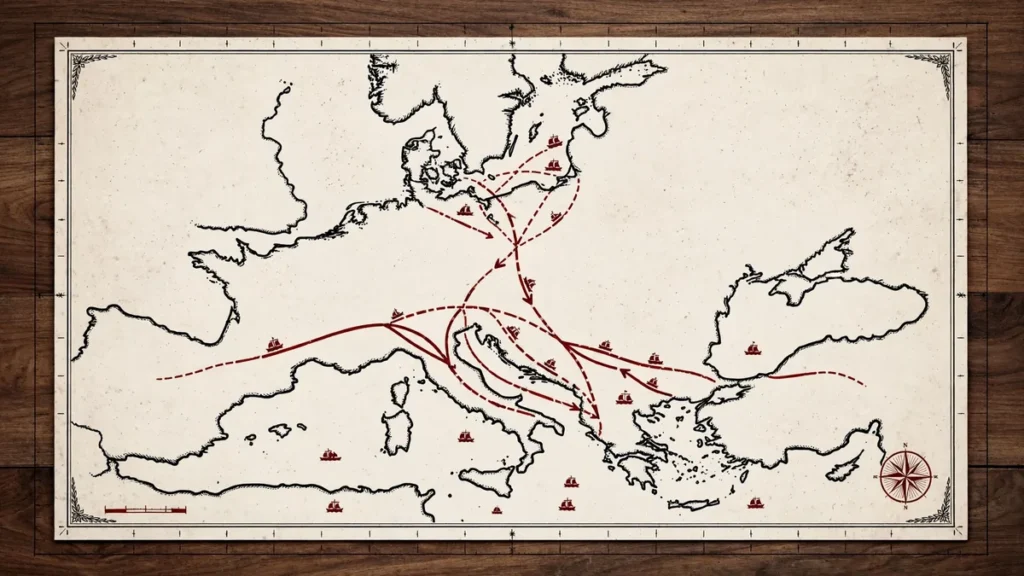
The Turkish group, built around the amphibious assault ship TCG Anadolu with the frigate TCG Gaziantep and the submarine TCG Gur, also focuses on the Mediterranean. Anadolu carries amphibious forces and Bayraktar TB3 unmanned aircraft, which operated off the Albanian coast near Vlore. On October 19, 2026, allied forces demonstrated an amphibious landing at the Pasha Liman naval base, helicopter operations, fast-roping and TB3 take-offs and landings from Anadolu’s deck.
The 17 participating nations are Albania, Croatia, Finland, France, Germany, Greece, Italy, Lithuania, Norway, Poland, Romania, Slovakia, Slovenia, Spain, Turkey, the United Kingdom and the United States.
Why NATO is running this activity now
Neptune Strike 26-4 sits in a wider European security moment. The same week it was under way, five European powers met in Paris and pledged to take greater responsibility for European security, covered in WarBrief’s report on the E5 Paris defence pledge. The political discussion and this military activity are different things, but both show European allies demonstrating, in public, that they can organise complex operations together.
The deterrence logic is plain: NATO describes the activity as strengthening deterrence, territorial defence and freedom of manoeuvre. The signal is that a crisis would meet a coordinated response, not separate national efforts. That signal is only as strong as the underlying capability, which is why the real test is mundane: communications, refuelling and shared procedures. Rear Admiral Eduardo Guitian Crespo, STRIKFORNATO’s Deputy Chief of Staff for Operations, put it this way:
“Our responsibility is to ensure that when the Alliance calls, our forces are ready to act together – with speed, precision and purpose. That confidence is built through rigorous planning, close coordination with Allied nations and the daily work of turning national capabilities into an integrated NATO force.”
What the activity tests, and what remains unproven
Four tests stand out: carrier integration, with three different groups under allied command at once; multi-domain integration, with missile batteries, tankers, fighters and amphibious troops working together, as seen in Finland and Albania; geographic span, across all three NATO Joint Operations Areas; and command, with STRIKFORNATO coordinating carriers, submarines and supporting aircraft for the Supreme Allied Commander Europe.
What remains unproven matters too. An exercise does not test wartime logistics at scale or political decision-making under fire. No casualty, cost or readiness figures have been published in the sources reviewed here, and this report does not invent them. Nor does the activity resolve questions about European defence spending or industrial capacity, visible at events such as Euronaval 2026 in Paris. Wider context is in WarBrief’s intelligence reports and conflict zones coverage. Finally, Neptune Strike is an alliance-wide vigilance activity, not a Black Sea operation.
Assessment and outlook
Neptune Strike 26-4 is a credible, if limited, demonstration of allied naval integration. The events in Finland and Albania show real multinational work, and its value lies in command practice: tankers refuelling another nation’s carrier aircraft and missile batteries firing in coordination with allied jets.
The limits are structural. The force disperses on November 5, and no permanent command or posture change has been announced in the sources reviewed. The deterrent signal depends on observers believing the same integration would hold in a crisis, which exercises cannot fully prove. The activity strengthens procedures and signals cohesion, but it does not by itself transform European defence.
Watch three things next: the close on November 5 and any NATO after-action summary; whether these command relationships reappear in later activities; and how the political track – pledges, budgets and industrial plans – develops alongside the military track.
Frequently asked questions
What is Neptune Strike 26-4?
NATO’s fourth enhanced vigilance activity of 2026, running October 16 to November 5, 2026. Led by STRIKFORNATO, it integrates allied forces across European waters to test readiness and command.
Which ships lead Neptune Strike 26-4?
HMS Prince of Wales (United Kingdom), ITS Cavour (Italy) and TCG Anadolu (Turkey) lead the three strike groups.
Is Neptune Strike 26-4 a combat operation?
No. It is a peacetime vigilance and training activity. It practises multinational command and signals deterrence, but it is not a deployment for war, and forces return to national command when it ends on November 5.
Sources
- USNI News: NATO Kicks Off Neptune Strike Across European Waters
- The Aviationist: Three Maritime Strike Groups Spearhead NATO’s Neptune Strike 26-4
- Defence Industry Europe: NATO says three maritime strike groups and forces from 17 allies are testing joint combat readiness in Neptune Strike 26-4