WarBrief Live | October 3, 2026 | Cybersecurity
On September 30, 2026, police in ten countries raided homes, seized servers, and took control of the dark-web leak site of KillSec, a ransomware crew whose alleged administrator is 16 years old. Operation KillSwitch is one of the most revealing ransomware takedowns of the year — and a clear case study for ransomware as a service explained in plain terms: developers built the tools, affiliates did the break-ins, and stolen data became the leverage. Here is how the machine worked, why a teenager could allegedly run it, and how investigators pulled it apart.
Key Takeaways
- Operation KillSwitch, led by German police with Europol and Eurojust, seized KillSec’s leak site, five central servers, and 110+ terabytes of stolen data on September 30, 2026.
- Three suspects were provisionally arrested; the alleged main operator is a 16-year-old detained in Alicante, Spain, while a Dutch national faces extradition to the United States.
- Ransomware-as-a-service works like a franchise: core developers supply the malware and payment infrastructure, and recruited affiliates carry out the intrusions for a cut of each ransom.
- KillSec used double extortion — stealing data before encrypting it — so victims faced public exposure even if they could restore their systems from backups.
What happened: Operation KillSwitch
On October 1, 2026, Europol announced the results of a coordinated strike carried out the day before against the KillSec ransomware group. The investigation was led by the Hamburg State Criminal Police Office and the Hamburg Public Prosecutor’s Office, with Europol’s European Cybercrime Centre and Eurojust coordinating across ten countries: Belgium, Finland, Germany, Greece, the Netherlands, Romania, Spain, Switzerland, the United Kingdom, and the United States. Private-sector investigators from Bitdefender and Group-IB supported the operation, including cryptocurrency tracing of the group’s alleged proceeds.
On action day, law enforcement took control of KillSec’s dark-web leak site, seized five central servers, redirected associated domains to a seizure notice, and secured at least 110 terabytes of stolen data against further unauthorized access. Eight properties were searched in Spain, Greece, Romania, and the United Kingdom, and three suspects were provisionally arrested. National investigations into the group had begun in early 2025.
Spanish police detained a 16-year-old Romanian national in Alicante described by investigators as KillSec’s suspected administrator and main operator, according to a Europol spokesperson quoted by Reuters. Two other suspects in their twenties were arrested in Britain and Romania. The man held in Britain — Dutch national Fouad Eltibrizi, allegedly known as “Archduke” — was indicted by a federal grand jury in Puerto Rico on September 16 on conspiracy and computer-damage charges, and faces extradition to the United States. A suspected developer who turned 18 in August 2026 has been identified but not arrested; suspected negotiator and affiliate roles are also mapped, and inquiries continue. Follow WarBrief Live’s Intelligence Reports hub for ongoing cyber disruption coverage.
How ransomware-as-a-service works
Ransomware-as-a-service is a criminal franchise model that splits the work between specialists — mirroring Europol’s role map of KillSec: administrator, developer, negotiator, affiliate. Core developers maintain the encryption malware, payment portal, and leak site. Affiliates, who need no coding skills, rent or join the platform, break into victim networks, and deploy the payload; each ransom is split between developer and affiliate. The FBI, CISA, and partner agencies describe this division of labor in their August 2026 joint advisory on the Gunra operation (advisory AA26-222A), noting it lets low-skilled actors launch sophisticated attacks with professionally built tools.
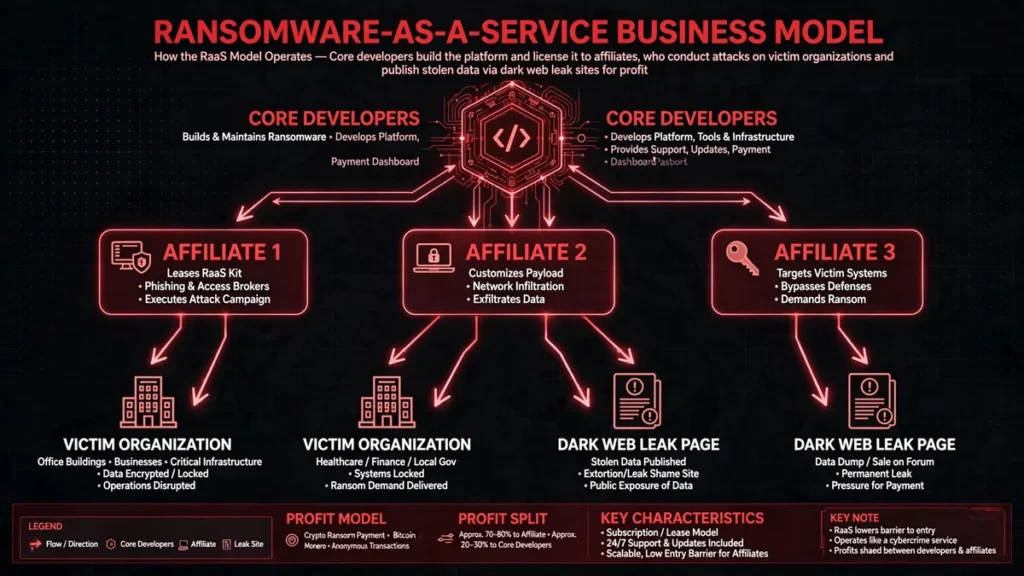
The table below maps the typical RaaS division of labor:
| Role | What they do | How they get paid |
|---|---|---|
| Core developers / operators | Build and update the encryptor, run payment portals and the leak site | Take a percentage of every ransom |
| Affiliates | Choose targets, break in, steal data, deploy the payload, negotiate | Keep the larger share of each ransom they collect |
| Access brokers | Sell stolen VPN or RDP credentials and unpatched entry points to affiliates | Flat fee per access sold |
| Negotiators | Handle ransom talks with victims via encrypted channels | Salary or cut, depending on the crew |
Recruitment happens on underground forums and encrypted messaging channels, often for a subscription or flat fee, with step-by-step guides included — the model has deliberately been engineered to lower the barrier to entry since the mid-2010s. That design choice is central to understanding the KillSec case: the operation did not require its leadership to be elite hackers, only organized ones.
Double extortion: why backups are no longer enough
The modern playbook adds a second squeeze: double extortion. Affiliates copy sensitive data out of the victim’s network first, then encrypt the systems. If the victim restores from backups and refuses to pay, the attackers threaten to publish the stolen data — creating legal, financial, and reputational pressure that survives even a clean recovery. CISA’s #StopRansomware advisories describe this as the default model: exfiltration before encryption, public disclosure as the price of non-payment.
KillSec fit the pattern. According to Europol, the group stole sensitive data by exploiting software vulnerabilities and poorly secured access points, favoring poorly secured cloud storage, and published victims’ files on its dark-web leak site when ransoms went unpaid. Europol says KillSec received “substantial” ransom payments. Around 1,000 suspected attacks worldwide are under investigation, about 500 confirmed successful — including at least 70 in Germany — and close to 300 victims were posted to the leak site, per Bitdefender. The group has been active since around 2024. Our explainer on CensysInspect, the internet scanner in your logs, covers how exposed systems like these get found.
Why a teenager could allegedly run the operation
The age of the suspected administrator — 16 — is less surprising inside the RaaS model than it looks. When malware, payment plumbing, and leak-site infrastructure are supplied as a service, the administrator’s job becomes management: recruiting affiliates, running negotiations, keeping the extortion machine online. Europol’s role map reads like a small company’s org chart: administrator, developer, negotiator, affiliate.
Two trends helped. Investigators found KillSec members used artificial intelligence to build and maintain infrastructure and identify victims, cutting the skill and labor needed to run the operation. And the affiliate economy supplies technical muscle on demand: forums, access brokers, and playbooks let a young operator coordinate experienced intruders without being one. Researchers have tracked crews skewing younger since the Scattered Spider and Lapsus$ cases put teenage hackers on investigators’ radar; KillSec’s fast growth, public leak site, and forum recruitment fit that pattern. The alleged crimes remain as serious as any organized-crime case.
How police dismantle a ransomware crew
Takedowns like KillSwitch take years. National investigations began in early 2025; Europol’s cybercrime center fused intelligence and supported crypto tracing and forensics, while Eurojust ran a coordination center so that arrests, searches, and seizures happened simultaneously — denying suspects the chance to destroy evidence or flee. The FBI’s Cyber Division separately announced its own “joint sequenced operation” against KillSec on October 1.
The targets are chosen to break the business model: seizing the leak site removes the extortion leverage, seizing servers cuts off access, domain seizures burn the brand, and crypto tracing follows the money. Examiners are still analyzing the seized material, which could reveal more victims and suspects. But disruption is not eradication — affiliates scatter and rebrand, which is why Europol stresses that inquiries continue. Europe is hardening its posture too: see the EU’s emergency security protocol for hybrid attacks and our lessons from cyber warfare in the Russia-Ukraine conflict.
What this means for businesses and cyber insurance
For executives and insurers, KillSwitch shows double extortion has broken the old recovery math: a backup restores servers but does nothing about stolen data. The FBI, CISA, and the MS-ISAC do not encourage paying ransoms — payment does not guarantee recovery or silence, and paying sanctioned-linked recipients creates legal exposure.
The recommended defenses are unglamorous: patch known exploited vulnerabilities in internet-facing systems, keep offline immutable backups in a segmented location, and segment networks to limit lateral movement. KillSec’s entry points — unpatched software, weak edge devices, exposed cloud storage — are closed by routine hygiene. Insurers are pricing this in, increasingly demanding proof of backups, patching, and tested response plans before paying ransomware claims.
What to watch next
Several threads remain live. Eltibrizi’s extradition fight will test how US prosecutors pursue overseas RaaS affiliates; the identified developer — an adult now, a minor during part of the alleged offending — poses a thornier prosecution question. Seized evidence is still being examined, so the victim count (about 500 confirmed successful attacks) may rise and more suspects may surface. The open question is whether KillSec’s affiliates scatter to rival crews or rebrand — after most major takedowns, the pattern is fragmentation, not disappearance.
Frequently asked questions
What is ransomware as a service?
Ransomware-as-a-service (RaaS) is a criminal business model in which core developers build the encryption malware, payment portals, and leak-site infrastructure, then lease them to affiliates who carry out the actual intrusions. Affiliates need little coding skill; each ransom is split between developer and affiliate. Europol says KillSec operated exactly this way, with defined administrator, developer, negotiator, and affiliate roles.
How do ransomware leak sites pressure victims into paying?
Leak sites enforce double extortion. Attackers steal data before encrypting systems, then post samples or countdown timers on a dark-web page, threatening full publication unless paid. This creates legal and reputational pressure that survives even a clean backup recovery — which is why KillSec could extort victims who might otherwise have restored their systems.
Why would a teenager be able to run a ransomware operation?
The RaaS model lowers the technical barrier: the malware and infrastructure are supplied as a service, recruitment happens on underground forums, and investigators found KillSec members used AI to help build infrastructure and pick targets. That lets a young operator coordinate experienced affiliates and run negotiations without writing novel exploits. It does not reduce the seriousness of the alleged crimes, which are being prosecuted as organized criminal activity.
Should a company pay the ransom?
The FBI, CISA, and the MS-ISAC advise against it: payment does not guarantee recovery or silence, and it funds further attacks. Involve legal counsel and incident-response professionals — paying sanctioned-linked entities creates additional legal exposure.
How can organizations defend against ransomware-as-a-service attacks?
Patch known exploited vulnerabilities in internet-facing systems, keep offline immutable backups in a segmented location, segment networks to limit lateral movement, and test incident-response plans with legal and communications teams. KillSec’s entry points — unpatched software, weak edge devices, exposed cloud storage — are closed by routine hygiene, not exotic defenses.
Sources
- BleepingComputer: Police dismantle KillSec ransomware gang allegedly led by 16-year-old
- Security Affairs: Operation KillSwitch — Police dismantle KillSec ransomware group
- Bitdefender: Bitdefender supported Operation KillSwitch — what the KillSec takedown means for defenders
- National Cyber Security: Spanish police arrest 16-year-old accused of running KillSec ransomware group
- QUE.com: CISA Gunra ransomware advisory maps double-extortion defenses (joint FBI/CISA advisory AA26-222A)