WarBrief Live | November 20, 2026 | Sanctions
On November 18, 2026, the US Treasury sanctioned three people and three entities accused of moving Iranian Revolutionary Guard money to Hezbollah through a charity front and a gold and cash smuggling network spanning Lebanon, Türkiye and Africa.
people designated
entities designated
cash seized from a courier in February 2025
counterterrorism authority used
Key Takeaways
- The US Treasury’s Office of Foreign Assets Control (OFAC) designated a Hezbollah-linked charity, its founder, two Lebanese brothers and two gold companies on November 18, 2026.
- The charity, the Wa Ta’awanu Association, is accused of channelling donor funds to Hezbollah under the cover of humanitarian relief in southern Lebanon.
- Brothers Hassan and Ibrahim Khechen are accused of moving funds from Iran’s Islamic Revolutionary Guard Corps-Qods Force (IRGC-QF) to Lebanon, using gold bullion, cash couriers and companies in Lebanon and Türkiye.
- The action is part of Operation Economic Outcast, the US economic-pressure campaign against Iran’s proxy networks, and it lands as pressure grows on Hezbollah to disarm.
What did the US Treasury announce on November 18?
The Treasury’s Office of Foreign Assets Control (OFAC) announced designations against three people and three entities connected to Hezbollah’s finances, in an action titled “Operation Economic Outcast Targets Iran’s Proxy Networks.” The designations were made under the US counterterrorism authority, Executive Order 13224, as amended. Reuters reported the action on November 18, and the Treasury published its full press release the same day.
Treasury Secretary Scott Bessent framed the move as a direct challenge to Iran’s influence in Lebanon. “The Iranian regime’s attempts to infringe on Lebanon’s sovereignty through terror proxies like Hizballah will not be tolerated,” Bessent said. “The U.S. government will continue to disrupt Iran’s attempts to exert influence in the region and fund its proxies.”
The Treasury said the action “exposes Hizballah’s continued exploitation of civilian charitable organizations” and increases pressure on the group’s illicit financing networks as Hezbollah resists growing calls and international pressure to disarm. The timing matters: the designations came the same week Israel struck a Hezbollah site in Lebanon’s Beqaa Valley, a development covered in WarBrief’s Lebanon conflict profile, and as the Lebanese government faces pressure to enforce disarmament in areas vacated by the Israeli military.
Who was designated — and what are they accused of doing?
The six designations fall into two groups: a charity accused of acting as a front, and a gold and cash smuggling network accused of moving Iranian money.
The first group is the Wa Ta’awanu Association and its founder, Afif Abdel Rida Chouman. Wa Ta’awanu is a Lebanon-based charity that provides emergency relief services in southern Lebanon. According to the Treasury, it also channels outside donor funds toward Hezbollah’s activities, giving the group cover under the guise of delivering humanitarian services. Chouman, the Treasury said, founded the charity, leads it and coordinates its activities at Hezbollah’s direction. Both were designated for allegedly providing material support to Hezbollah.
The Treasury also tied the charity to the disarmament standoff in southern Lebanon. Under the June 26, 2026 Trilateral Framework between the United States, Lebanon and Israel, the Lebanese Armed Forces moved in July 2026 into areas previously held by the Israeli military. The Treasury said Wa Ta’awanu “provides a pretext for Hizballah’s militant activities in the pilot zones, preventing disarmament and inhibiting Lebanese government efforts to safeguard these areas.”
The second group is the smuggling network. Lebanese businessman and money changer Hassan Khechen and his brother Ibrahim Khechen are accused of transferring significant funds from the IRGC-QF to Lebanon on behalf of Hezbollah, in coordination with the group’s financial officials. Hassan Khechen owns Lebanon-based Gold Global Company, which the Treasury said he uses to transfer money from several transit countries to Lebanon for Hezbollah. The network also employs couriers to move cash across international borders. Ibrahim Khechen, the Treasury said, has links to a related courier who was arrested in February 2025 at Beirut airport with $2.5 million in his hand luggage.
The sixth designation is Türkiye-based Sankari Gold Kuyumculuk Ticaret Limited Sirketi (Sankari Gold), which the Treasury described as Hezbollah-affiliated and controlled by Hassan Khechen. It allegedly assists Gold Global Company in moving gold bullion and cash from Africa.
| Metric | Figure | Source |
|---|---|---|
| People designated | 3 | US Treasury (CONFIRMED) |
| Entities designated | 3 | US Treasury (CONFIRMED) |
| Cash carried by arrested courier | $2.5 million, February 2025, Beirut airport | US Treasury (CONFIRMED) |
| Hezbollah designated a Foreign Terrorist Organization | October 8, 1997 | US State Department, via Treasury (CONFIRMED) |
| Hezbollah designated a Specially Designated Global Terrorist | October 31, 2001 | US State Department, via Treasury (CONFIRMED) |
| OFAC designated Hezbollah as IRGC-QF-controlled | August 20, 2026 | US Treasury (CONFIRMED) |
| Operation Economic Outcast launched | August 24, 2026 | Reported by Rudaw (REPORTED) |
Figures marked CONFIRMED come from the US Treasury press release or Reuters reporting of it. The campaign launch date is reported by Rudaw and has not been independently confirmed from a Treasury release in this article.
How does the Hezbollah gold smuggling network work?
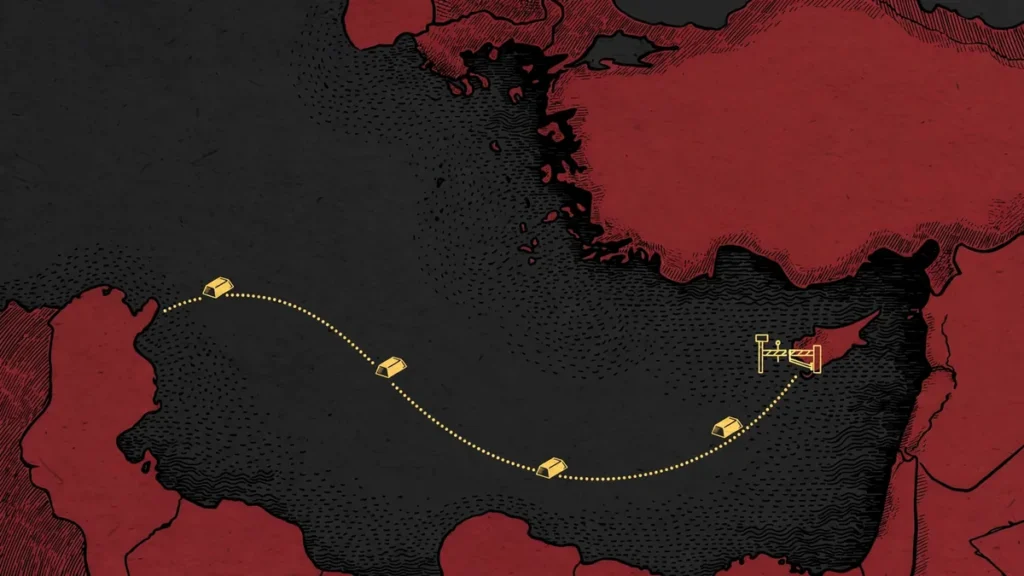
Gold is useful to a sanctions-evasion network because it is portable, holds its value across borders and can be sold almost anywhere. According to the Treasury’s account, the Khechen network used that logic in three stages: money and gold moved out of Africa through Türkiye-based Sankari Gold, onward through Gold Global Company in Lebanon, and into Hezbollah’s hands via transfers arranged with the group’s financial officials.
Cash couriers formed the second leg. The Treasury said the network employs couriers to transfer funds in cash across borders, and pointed to the February 2025 arrest at Beirut airport, where a related courier was caught with $2.5 million in hand luggage. The arrest, which predates these designations by more than a year, is the clearest public evidence of the network’s methods — and a sign that Lebanese and international authorities were already tracking the route before OFAC acted.
The charity channel worked differently. Rather than moving physical value, Wa Ta’awanu allegedly moved donor money: funds raised abroad for humanitarian relief in southern Lebanon were, according to the Treasury, diverted toward Hezbollah’s activities. That is why the Treasury framed the action as exposing the “continued exploitation of civilian charitable organizations” — the charity label itself was part of the mechanism.
What measures are now in place?
Designation under Executive Order 13224 triggers a standard set of US measures. All property and interests in property of the designated people and entities that are in the United States, or in the possession or control of US persons, are blocked and must be reported to OFAC. Any entity owned 50 percent or more, directly or indirectly, by one or more blocked persons is also blocked. US persons are generally prohibited from transactions involving the designated parties’ property, unless authorised by a general or specific OFAC licence.
The measures reach beyond US borders in two ways. Foreign financial institutions that knowingly conduct or facilitate significant transactions for a designated person risk secondary sanctions, including restrictions on opening or maintaining correspondent or payable-through accounts in the United States. And violations can draw civil penalties — imposed by OFAC on a strict-liability basis — or criminal penalties for US and foreign persons.
For context, these are the same tools OFAC has applied across the wider Iran sanctions programme. WarBrief’s November 13 entry on OFAC’s secondary-sanctions warnings covers the 1,000-plus Iran entries that now carry explicit warnings, and the Iran sanctions overview explains how Iran became America’s top sanctions target, with 1,574 OFAC listings. The full list of measures and designations is maintained on the Treasury’s OFAC site and in the WarBrief Sanctions Tracker.
This entry is educational content about sanctions policy. It is not legal advice; anyone with a compliance question should consult a qualified sanctions lawyer or OFAC’s published guidance.
What does this mean for US, UK and EU readers?
For banks and businesses, the designations add six names — and the companies they control — to the screening lists that compliance teams already run against the SDN list. Gold traders and jewellers should note the specific risk the Treasury highlighted: bullion moving from Africa through Türkiye to Lebanon is now a named laundering route, and firms handling gold from those corridors face sharper due-diligence questions. The secondary-sanctions warning matters most for non-US banks, which can lose US correspondent banking access for knowingly facilitating significant transactions for designated persons.
For travellers and donors, the charity angle is the practical warning. Donations to Lebanon relief appeals should go through established, audited organisations; the Treasury’s case is that at least one charity was diverting donor money to an armed group. For readers following the Lebanon story, the designations are one half of a two-track squeeze: financial pressure from Washington and military pressure on Hezbollah’s positions, with the Lebanese government caught between disarmament demands and the risk of renewed conflict.
What is the impact on Hezbollah’s finances?
The Treasury’s stated aim is to raise the cost of moving Iranian money to Hezbollah at a moment when the group is under pressure to disarm. Cutting off a charity front and a gold route removes two channels at once — one that raised money from donors, and one that moved physical value across borders. The designations also signal to banks in Lebanon, Türkiye and transit states that handling Khechen-linked funds carries secondary-sanctions risk, which tends to push legitimate institutions away from the network faster than the blocking orders alone.
The limits are real. Designation does not seize assets held outside US jurisdiction, and the network’s couriers and cash routes can adapt. The February 2025 airport arrest shows enforcement can intercept the physical leg, but only when authorities are watching the right passengers. Whether the measures bite will depend on follow-through: Lebanese enforcement against the charity and Gold Global, Turkish action on Sankari Gold, and whether banks treat the 50-percent ownership rule as a reason to exit related accounts.
What to watch next in the Hezbollah finance crackdown
- Lebanese enforcement: whether Beirut acts against Wa Ta’awanu, Gold Global Company or the Khechen brothers, and whether the charity’s relief operations in the south are wound down or replaced.
- Turkish action: whether Ankara moves against Sankari Gold, and what that means for gold flows through Türkiye.
- Next OFAC tranches: Operation Economic Outcast has already produced multiple rounds against Iran-linked networks; further designations targeting Hezbollah’s remaining financiers would show the campaign is widening rather than a one-off.
- EU and UK follow-up: whether European allies mirror the designations, which would close more banking doors for the network.
- The disarmament clock: how the designations interact with the Trilateral Framework pilot zones and the Lebanese Armed Forces’ deployment in the south.
Frequently asked questions
What is the Wa Ta’awanu Association?
Wa Ta’awanu is a Lebanon-based charity that provides emergency relief services in southern Lebanon. The US Treasury says it also channels outside donor funds toward Hezbollah’s activities and gives the group cover under the guise of humanitarian work. Its founder, Afif Abdel Rida Chouman, was designated alongside the charity on November 18, 2026.
Who are Hassan and Ibrahim Khechen?
Hassan Khechen is a Lebanese businessman and money changer who owns Gold Global Company in Lebanon; his brother Ibrahim Khechen is also accused of participating in the network. The Treasury says they transferred significant funds from Iran’s Islamic Revolutionary Guard Corps-Qods Force to Lebanon on behalf of Hezbollah, using gold, cash couriers and companies in Lebanon and Türkiye.
What happens to the designated people and companies under US sanctions?
Their property and interests in property in the United States, or held by US persons, are blocked and must be reported to OFAC. US persons are generally barred from transactions with them, entities they own 50 percent or more of are also blocked, and foreign banks that knowingly facilitate significant transactions for them risk secondary sanctions.
What is Operation Economic Outcast?
Operation Economic Outcast is the US economic-pressure campaign against Iran’s financial networks, oil revenues, sanctions evasion and support for regional armed groups. The November 18 designations against Hezbollah-linked targets were issued under the campaign; Rudaw reported it was launched on August 24, 2026.
Is Hezbollah already sanctioned by the US?
Yes. The US State Department designated Hezbollah as a Foreign Terrorist Organization in 1997 and as a Specially Designated Global Terrorist in 2001. OFAC designated Hezbollah itself under Executive Order 13224 on August 20, 2026, for being owned or controlled by the IRGC-Qods Force. The November 18 action targets the group’s financiers and front organisations, not the group itself.
Sources
- US Department of the Treasury: Operation Economic Outcast Targets Iran’s Proxy Networks
- Reuters: US sanctions Hezbollah-linked charity in push against Iran’s proxies, Treasury says
- Tribune India (ANI): US sanctions three Lebanese individuals, entities over alleged financial links to Hezbollah
- Rudaw: US sanctions Hezbollah charity, Iranian-backed smuggling networks