WarBrief Live | November 9, 2026 | Sanctions
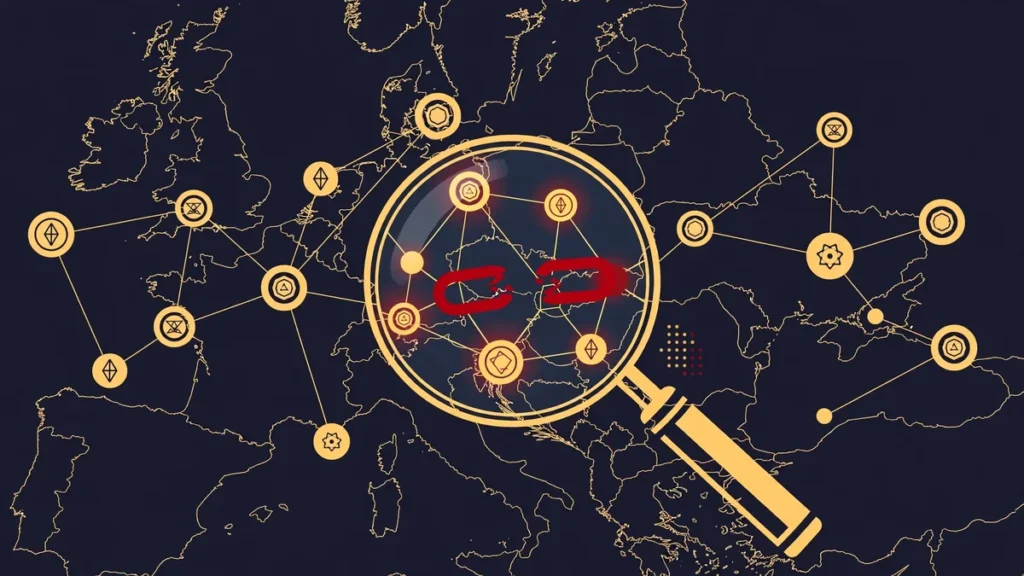
The European Union has launched a Crypto Sanctions Task Force to hunt crypto routes used to evade its sanctions on Russia. Announced on November 5, 2026, it brings together European Commission and member-state experts to design measures that close digital-asset loopholes — but it arrives without a published mandate, budget or start date, and it imposes no new bans by itself.
Key Takeaways
- Announced November 5, 2026, after the tenth meeting of the High-Level Expert Group on Union Restrictive Measures in Brussels.
- An informal coordination body of Commission and member-state experts, initially envisaged to run for 12 months, drawing on expertise from Ukraine and the UK.
- It builds on the 21st Russia sanctions package (July 23, 2026), which banned EU operators from dealing with 14 crypto platforms linked to Russian value flows.
- No mandate, budget, staffing plan or start date has been published, and the announcement itself bans no transactions.
What the Crypto Sanctions Task Force is
The task force is the European Commission’s new enforcement-coordination body for one problem: crypto assets being used to get around EU financial sanctions, above all the sanctions on Russia. Commissioner for Financial Services Maria Luís Albuquerque announced it at the close of the tenth meeting of the High-Level Expert Group on Union Restrictive Measures, the forum where member states, the Commission and the European External Action Service coordinate sanctions implementation. “That is why I am pleased to announce the launch of the EU Crypto Sanctions Task Force,” Albuquerque said in the Commission statement published on November 6. “This is an important step in strengthening our capacity to detect and tackle attempts to circumvent EU financial sanctions through crypto assets.”
Commission spokesperson Siobhan McGarry told journalists on November 6 that the task force is an informal body combining national and Commission expertise, and that its job is to develop measures addressing crypto as a sanctions-evasion route. “Crypto is a tool that has been used to circumvent our sanctions,” McGarry said. An EU diplomat told the Kyiv Independent the task force is initially envisaged to work for 12 months and will draw on expertise from Ukraine and the UK. The task force does not itself designate people or freeze assets: any new bans or listings must still come through the EU’s normal sanctions decisions.
The sanctions the task force is meant to enforce
The 21st Russia sanctions package, adopted by the Council on July 23, 2026 — 106 days before the task force announcement — reached directly into crypto networks: it banned EU operators from dealing with 14 crypto platforms based in Georgia, Panama, the United Arab Emirates, the Marshall Islands, Kyrgyzstan and Belarus. On April 23, 2026, the EU had imposed a sector-wide ban on crypto providers and platforms established in Russia, and in October 2025 it prohibited transactions involving A7A5, a ruble-backed stablecoin.
Allied alignment is moving in step. On November 4, the Swiss Federal Council decided to adopt the 21st package’s measures; its economics department had decided on November 3 to add 254 individuals, companies and entities to the Swiss asset-freeze list, and to ban transactions involving 33 Russian banks and 17 financial institutions and crypto service providers. The list changes took effect at 11pm on November 4, with sectoral measures following on November 5.
What happened on November 5 and 6
- November 5 (morning): Albuquerque chairs the tenth High-Level Expert Group meeting in Brussels. The agenda covers crypto assets as a circumvention route, the European Anti-Fraud Office’s investigative work, and consistent national enforcement.
- November 5 (afternoon): EU Sanctions Envoy David O’Sullivan convenes the eighth Sanctions Coordinators Forum with partners from the United Kingdom, the United States, Japan, Canada, Australia, New Zealand, South Korea, Liechtenstein, Norway, Switzerland, Iceland and Ukraine.
- November 5: Albuquerque announces the Crypto Sanctions Task Force and a dedicated internal sanctions office, which she said “will strengthen coordination, provide faster guidance to Member States and improve data sharing and analysis.”
- November 6: The Commission publishes Albuquerque’s statement; McGarry briefs the press and says the Commission is working on a 22nd sanctions package against Russia.
- November 6: In a parallel US action, the Treasury’s Financial Crimes Enforcement Network bars US financial institutions from processing fund transfers for crypto exchange MEXC Global, citing at least $16.7 billion in transactions tied to sanctions evasion and cybercrime. Read our coverage of the MEXC action and Operation Economic Outcast.
What the announcement changes — and what it does not
The clearest change is institutional. Until now, crypto circumvention was handled through package-by-package bans and national enforcement that Albuquerque herself described as uneven. A standing task force gives the Commission a place to pool expertise, compare what member states are seeing, and draft the next round of measures from shared evidence — and the parallel sanctions office, covering the whole lifecycle from policy design to circumvention, points the same way. What it does not change, yet, is the law: no new transaction ban, listing or designation came with the announcement, and the Commission has published no mandate, budget, staffing plan or start date. As Albuquerque put it, “adopting sanctions is only the beginning. Their real impact depends on how effectively and consistently we implement and enforce them.” For readers, the practical effect is on compliance, not everyday crypto use: firms operating in or with the EU should expect closer scrutiny of Russian-linked flows, while the announcement itself changes nothing for lawful users. This entry is educational content about sanctions policy; it is not legal advice.
What to watch next in EU crypto sanctions
Four things will show whether the task force becomes more than an announcement: a published mandate; a date for its first working session; the contents of the 22nd Russia sanctions package, which the Commission says is in preparation; and whether the promised Ukrainian and British expertise arrives as formal participation or informal consultation. For the wider picture, see the WarBrief Live Sanctions Tracker, and our earlier report on Operation Economic Outcast, the US campaign against Iran’s weapons-procurement networks.
Frequently asked questions
What is the EU Crypto Sanctions Task Force?
An informal body announced by the European Commission on November 5, 2026, bringing together Commission and member-state experts to detect crypto routes used to circumvent EU financial sanctions, particularly those against Russia, and to design measures that close those loopholes.
Does the task force ban any crypto transactions?
No. The announcement itself bans nothing. Any new bans or listings must come through the EU’s normal sanctions decisions. Existing bans, including the 21st package’s ban on dealings with 14 crypto platforms, remain in force.
Why is the EU targeting crypto in its Russia sanctions?
Because, in the Commission’s words, crypto has been used to circumvent its sanctions. Digital assets can move value across borders outside the banking system, so Brussels has progressively restricted crypto services linked to Russia, including a sector-wide ban on Russia-established crypto providers in April 2026.
Sources
- European Commission: Statement by Commissioner Albuquerque on the outcomes of the tenth meeting of the High-Level Meeting on sanctions implementation
- Kyiv Independent: EU expands Ukraine sanctions push with new office and crypto task force
- Agence Europe: Creation of internal European Commission office dedicated to EU sanctions across entire economic lifecycle
- Swiss Federal Council: Ukraine: Federal Council implements 21st package of sanctions
- Blockchain Reporter: EU Crypto Sanctions Task Force Targets Russia
- EU Perspectives: Russian token moved $102bn. Brussels answers with sanctions office