WarBrief Live | November 9, 2026 | Intelligence Report
Task Force Iron Gate is a 20-person US Central Command cell, based in Tampa, Florida, that coordinates American agencies to disrupt Iran’s movement of weapons, dual-use technology, sanctioned goods and illicit revenue across its land borders and the Caspian Sea.
CENTCOM announced the unit on Saturday, November 7, 2026, as the land-based counterpart to the naval blockade Washington says has stopped more than $25 billion in crude oil exports. Trump called it “in full force and effect”; the IRGC dismissed it as “just a play on words”.
Key Takeaways
- CENTCOM stood up Task Force Iron Gate on November 7, 2026: about 20 staff in Tampa, coordinating US agencies against Iran’s land and Caspian supply routes.
- It extends a naval blockade in place since April 13, which CENTCOM says has blocked over $25 billion in Iranian crude exports.
- Trump says renewed strikes are “highly unlikely” if nuclear talks progress and the Strait of Hormuz reopens.
- Analysts are sceptical: the US has no military presence on the Caspian Sea, and Iran’s 5,900 km of borders run through seven neighbours.
What is Task Force Iron Gate?
Task Force Iron Gate is a small coordination cell, not a deployed force. CENTCOM said its commander, Admiral Brad Cooper, directed its formation on November 7, and that it will comprise approximately 20 civilian and military personnel based in Tampa, Florida. Its job, in CENTCOM’s words, is to coordinate with other US government agencies on “preventing the movement of advanced weapons systems, dual-use technologies, sanctioned materials, and illegal revenue streams across Iran’s land borders and the Caspian Sea”. Reuters reported the partners were expected to include Treasury, State, Justice and intelligence officials.
Cooper said: “The establishment of Task Force Iron Gate reinforces the success of our ironclad blockade against Iran at sea.”
Why is Washington targeting land routes now?
The task force is the second half of a campaign that began at sea: the US imposed its naval blockade of Iranian ports on April 13, 2026, and CENTCOM says it has since stopped more than $25 billion in Iranian crude exports.
Washington’s reasoning is that pressure at sea alone displaces the problem. As Trump rejected a seven-day roadmap for ending the conflict on November 8, and as US strikes on Qeshm Island continued, CENTCOM moved to cover the routes Iran could use instead: overland crossings into Iraq, Turkiye, the Caucasus, Central Asia, Pakistan and Afghanistan, and shipping across the Caspian Sea. Former Pentagon official Michael Mulroy told Al Jazeera the unit would find where “weapons systems are coming in, how they could potentially be cut off”.
Which routes and neighbours are in the frame?
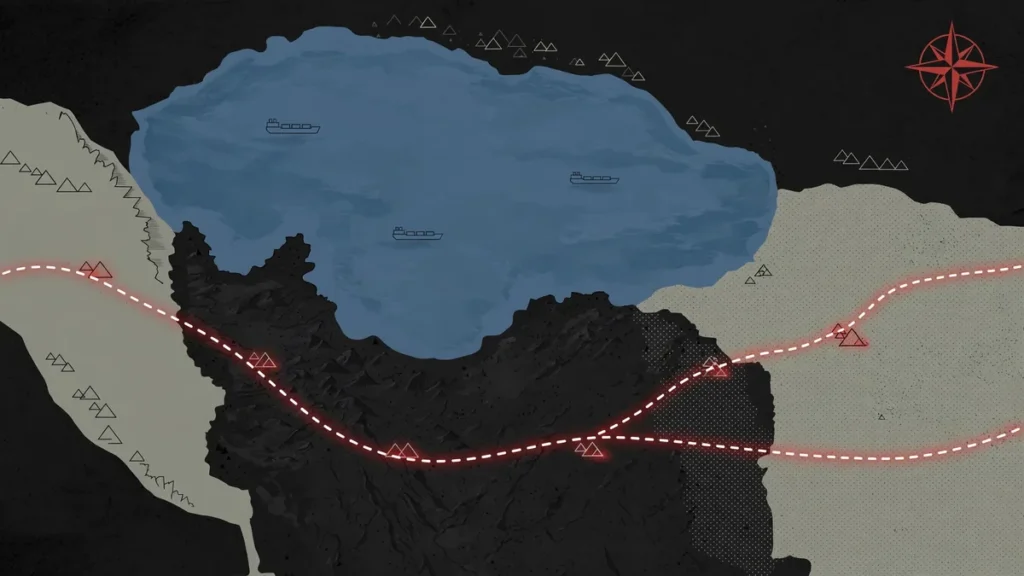
Iran shares land borders with seven countries — Afghanistan, Armenia, Azerbaijan, Iraq, Pakistan, Turkiye and Turkmenistan — totalling about 5,900 kilometres (3,660 miles). That geography is the task force’s central problem: each border is a trading ecosystem, and CENTCOM has named neither its focus crossings nor any enforcement methods or legal authorities.
The Caspian Sea is the more complicated half of the mandate. US media have reported that Russia has sent drone components and explosives to Iran via the Caspian Sea, and there are claims that Russian technology could be helping Iran develop advanced supersonic cruise missiles. Those reports are unconfirmed, but Mahjoob Zweiri, a professor at Qatar University, told Al Jazeera that reports of military equipment imported via Russia were a “real concern” for the United States — and warned the task force could “cause a confrontation with Russia”. Tehran has adapted before: seven tankers hid in plain sight by spoofing AIS signals.
Can a 20-person cell in Tampa really choke Iran’s supply lines?
As an intelligence and coordination body, the unit can plausibly map the networks, share targeting and sanctions packages with allies, and squeeze specific shipments and financiers. As a physical blockade of 5,900 km of border, it cannot. The US has no military presence on the Caspian Sea, Zweiri noted, and would need littoral states such as Azerbaijan or Armenia to cooperate — unlikely, in his view, as they do not want to upset Russia.
Rami Khouri, a policy fellow at the American University of Beirut, argued Iran’s trading networks make the mission near impossible: “it’s virtually impossible for the US to seal off every one.” The IRGC made the same point in its terms: spokesman Sardar Mohebi called the plan “just a play on words”. The same day, the IRGC announced plans for underground complexes to sustain missile and drone production under bombardment.
Assessment and outlook
Task Force Iron Gate is best understood as an economic-warfare coordination cell, not a new military front. Its most likely effects are incremental: sharper sanctions designations, more interdictions of specific cargoes, and higher costs for Iran’s procurement networks. A complete sealing of Iran’s land borders is not a realistic objective. The risks run both ways: action against Russian-linked Caspian shipments could become a friction point with Moscow; few visible results would let Tehran claim American pressure has reached its limits.
What this means for US, UK and EU readers
For energy markets, the immediate effect is modest: land routes move weapons and dual-use goods, not bulk oil. The risk to watch is escalation — any move from economic pressure to renewed strikes would hit oil prices, shipping insurance and Gulf airspace within hours. For businesses, the practical consequence is compliance: expect fresh US designations against front companies and facilitators. This is educational analysis, not financial advice.
What to watch next
- First enforcement actions: any named interdiction or sanctions designation credited to Iron Gate coordination.
- Neighbour responses: statements from Iraq, Turkiye, Azerbaijan, Armenia and Pakistan on border cooperation, and any Russian pushback over Caspian shipments.
- The Abu Dhabi talks: whether the task force is presented as leverage for negotiations or as preparation for renewed strikes.
Frequently asked questions
What is Task Force Iron Gate?
A 20-person US Central Command coordination cell, based in Tampa, Florida, announced on November 7, 2026, to disrupt the movement of advanced weapons, dual-use technology, sanctioned materials and illicit revenue across Iran’s land borders and the Caspian Sea.
How much Iranian oil has the naval blockade stopped?
CENTCOM says the blockade, in place since April 13, 2026, has prevented Iran from exporting more than $25 billion in crude oil. That is CENTCOM’s own figure, not an independently verified total.
Can the United States seal Iran’s land borders?
Analysts doubt it. Iran has about 5,900 km of borders with seven neighbours, and the US would need their cooperation to police them. Experts quoted by Al Jazeera call a full seal virtually impossible, though targeted interdictions are realistic.
Sources
- Al Jazeera: US task force to cut off Iran’s transport of advanced weapons: What we know
- Al Jazeera: US launches task force to disrupt Iran’s land-based supply routes
- Haaretz: US military launches task force to restrict Iran’s land-based arms trade (first reported by Reuters)
- Arab News: US launches task force to disrupt land transit routes into Iran
- The Straits Times: Trump says he is highly unlikely to order Iran strikes if talks progress
Read next: Intelligence Reports | Iran’s Seven-Day Roadmap: What Trump Rejected | US Strikes on Qeshm Island