WarBrief Live | November 7, 2026 | Conflict Zone
South Korea formally proposed military talks with North Korea on October 23, 2026, to pin down the exact line of their border and restore severed communication channels. Two weeks later, Pyongyang has effectively rejected the offer, resumed propaganda broadcasts and fired another projectile into the sea — leaving the world’s most heavily fortified frontier without a working channel to prevent an accidental clash.
Key Takeaways
- Seoul proposed inter-Korean military talks on October 23, 2026, to confirm the Military Demarcation Line, restore hotlines and prevent accidental clashes.
- Pyongyang has not formally answered; Kim Yo Jong dismissed the proposal and the Foreign Ministry said on November 6 it would never discuss its territory with “the enemy state”.
- The trigger was a September 21 mine blast that injured three South Korean soldiers; a joint investigation found the mines were deliberately planted about 10 metres south of the demarcation line.
- North Korea fired an unidentified projectile toward the East Sea on November 4, hours after Kim Yo Jong said dialogue with Washington remained possible but unnecessary.
Overview: a border with no working hotline
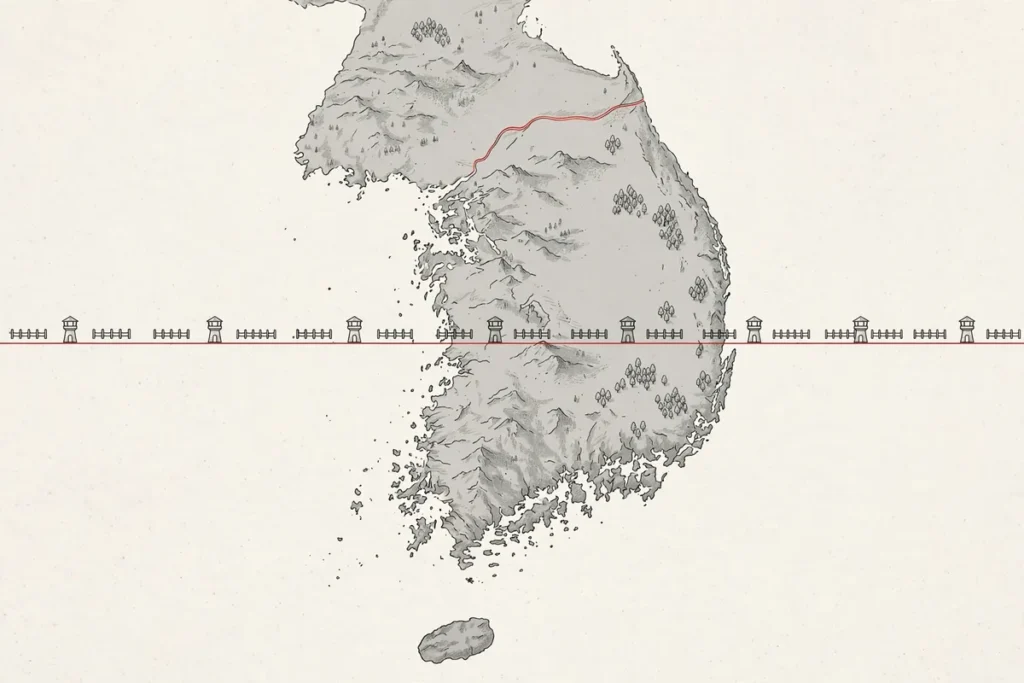
The Demilitarized Zone (DMZ) is the roughly 250-kilometre-long, 4-kilometre-wide buffer that has separated the two Koreas since the 1950–53 Korean War ended in an armistice. There was never a peace treaty, so the two sides remain technically at war, and the Military Demarcation Line (MDL) running through the middle of the zone is the de facto border. The last round of general-level military talks was held in October 2018, and the military communication lines between the two sides have been severed for years.
Tensions have climbed through 2026 as North Korea has reinforced its side of the DMZ with mines, barriers and fencing since 2024, in what it describes as establishing a permanent border. South Korea says that fortification work itself violates the armistice — and the September mine explosions turned a long-running dispute into an active crisis.
Key actors
South Korea: President Lee Jae Myung’s government has pursued dialogue, with the Defence Ministry making the formal talks proposal and the Foreign Ministry taking the mine-blast case to the United Nations Security Council. Deputy Minister for National Defence Policy Kim Hong-cheol announced the proposal in Seoul.
North Korea: Kim Jong Un’s government, with his sister Kim Yo Jong as its most visible spokesperson, has rejected talks outright and framed the border dispute as a matter of sovereignty to be settled by force, not negotiation.
United Nations Command (UNC): the United States-led command that administers the Armistice Agreement. Seoul has said three-way talks involving the UNC are possible, and the UNC’s determination that the mine-laying violated the armistice underpins South Korea’s case. United States: President Donald Trump has said he wants to meet Kim Jong Un later this year, with speculation about a meeting around the APEC summit in China in mid-November; South Korean officials say they see little chance of one for now.
Recent developments
- September 21, 2026: Explosions in the western DMZ injure three South Korean soldiers, two seriously. Seoul blames North Korean mines; Pyongyang denies responsibility and calls the incident a fabrication.
- September 30, 2026: The United Nations Command determines the mine-planting was a clear violation of the Armistice Agreement.
- October 5, 2026: South Korea’s Joint Chiefs of Staff, with the UNC, announce final findings: forensic analysis confirmed the blasts were caused by resin-cased anti-personnel mines deliberately planted by North Korean forces about 10 metres south of the MDL.
- October 21, 2026: Kim Yo Jong announces new North Korean military units have moved into “firing positions” along the border and threatens to switch on propaganda loudspeakers along the entire border within October.
- October 22, 2026: North Korea says it will resume anti-South Korean propaganda broadcasts. The same day, South Korea’s ambassador to the UN sends a letter to the Security Council president about the blasts; it is later registered as document S/2026/836.
- October 23, 2026: South Korea’s Defence Ministry formally proposes military talks to verify the precise location of the land MDL, discuss restoring military communication lines and prevent accidental clashes, with dates and venue to be discussed through Panmunjom. A similar proposal the previous November went unanswered.
- October 25, 2026: North Korea sends its own letter to the Security Council president, denying responsibility and accusing Seoul of violating the UN Charter through its warning shots.
- October 30, 2026: Kim Yo Jong rejects the talks proposal, calling it a “delusion not worth responding to” and dismissing bilateral talks as “the climax of the farce”.
- November 2–3, 2026: The UN releases South Korea’s letter, which demands an apology and the removal of the mines but stops short of asking the Council to convene a meeting or issue a statement.
- November 4, 2026: Kim Yo Jong says dialogue with Washington remains a path to peace but that Pyongyang sees no need for talks, and denies North Korea was behind the theft of more than $6 billion in cryptocurrency from Binance. Hours earlier, North Korea fired an unidentified projectile toward the sea off its east coast. Read our analysis of the November 4 launch and what it signals for US talks.
- November 6, 2026: North Korea’s Foreign Ministry says it will “never discuss with the enemy state in any case within our territory” and will defend its sovereign domain “not through negotiations but through a thorough exercise of force”.
Current status
As of November 7, 2026, South Korea’s offer remains unanswered in any formal sense, and every signal from Pyongyang points the other way: rejection of dialogue, new units in firing positions, resumed propaganda broadcasts and a fresh projectile launch. Seoul has kept the door open — President Lee has called for the North to return to dialogue — but it has also put its case on the Security Council’s record. The practical risk is immediate: with no hotline, no agreed border line in disputed stretches and troops from both sides working within metres of each other in a mined buffer zone, a misread movement or a second blast could escalate before either side can talk it down. For the wider picture, see our conflict zones hub.
What to watch
Whether the loudspeakers switch on: confirmation that propaganda broadcasts have resumed along the entire border would mark a further step away from the quiet that held for much of 2025. Further weapons tests: North Korea has carried out a series of tests in 2026, including a missile that flew more than 900 kilometres; another launch before the APEC summit would signal Pyongyang is closing the door on a Trump meeting. The APEC summit, November 18–19: Trump has said he expects to meet Kim Jong Un; any movement — or a definitive refusal — will set the tone for US–North Korea diplomacy into 2027. Any incident in the DMZ: with the minefields still in place and no communication channel, the next blast or border-crossing incident is the most likely trigger for sudden escalation.
Frequently asked questions
What is the Military Demarcation Line?
The MDL is the line drawn through the centre of the Demilitarized Zone when the Korean War armistice was signed in 1953. It is the de facto border between North and South Korea, but the two sides disagree on its precise location in some stretches — one reason Seoul proposed talks to verify it jointly.
Has North Korea accepted the talks?
No. Pyongyang has not formally replied to the October 23 proposal. Kim Yo Jong dismissed it as a “delusion not worth responding to”, and the Foreign Ministry said on November 6 it would never discuss its territory with “the enemy state”.
What happened in the September 21 mine blast?
Explosions inside the western DMZ injured three South Korean soldiers, two seriously. A joint investigation by South Korea’s Joint Chiefs of Staff and the United Nations Command concluded the blasts were caused by resin-cased anti-personnel mines deliberately planted by North Korean forces about 10 metres south of the MDL. Pyongyang denies responsibility.
Sources
- Al Jazeera: South Korea invites North for military talks over border
- Al Jazeera: North Korea to resume propaganda broadcasts, South Korea urges dialogue
- Yonhap: U.N. releases S. Korea’s letter decrying N.K. mine blasts, defending border warning shots
- ThePrint / Reuters: North Korea says US talks remain an option, but Binance hack accusation shows “hostile policy”
- NoCut News: North brushes off military talks proposal
- Korea JoongAng Daily: Seoul proposes renewed talks over border dispute