
The development of autonomous weapons systems represents one of the most consequential developments in military technology since the invention of gunpowder. These systems, capable of selecting and engaging targets without human intervention, promise to transform the character of armed conflict while simultaneously raising profound ethical, legal, and strategic questions. As nations race to develop and deploy increasingly autonomous capabilities, the international community faces urgent challenges in establishing frameworks for responsible development and use.
Defining Autonomous Weapons Systems
Autonomous weapons systems exist on a spectrum of human-machine interaction. Remotely operated systems like the MQ-9 Reaper drone maintain a human operator in the loop for all targeting decisions. Semi-autonomous systems can engage targets independently under specific conditions, with human supervision. Fully autonomous systems, sometimes called lethal autonomous weapons, would select and engage targets entirely without human intervention. Most current military systems operate at the lower end of this spectrum, but the trajectory toward greater autonomy is clear.
The US Department of Defense defines autonomous weapons as systems that, once activated, can select and engage targets without further human intervention. This definition has guided US policy, which currently prohibits the development of fully autonomous lethal systems but allows for increasingly automated targeting under human supervision. Other nations have adopted different approaches, with some pursuing greater autonomy and others calling for comprehensive bans.

Strategic Drivers
Several strategic considerations drive the development of autonomous weapons. The operational advantages are substantial: autonomous systems can react faster than humans, operate for extended periods without fatigue, and be deployed in environments too dangerous for human personnel. In contested electromagnetic environments where communications may be disrupted, autonomous operation ensures systems can continue to function effectively.
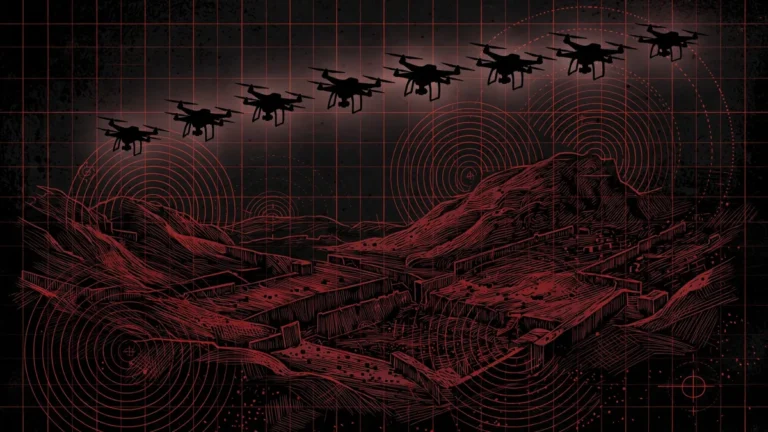
Military planners also see autonomous systems as a solution to the problem of mass. Peer competitors like China are developing large numbers of relatively inexpensive autonomous systems that could overwhelm adversary defenses through sheer numbers. The concept of swarming, in which large numbers of autonomous drones coordinate their actions without direct human control, presents particularly challenging tactical problems for traditional air defense systems.
Ethical and Legal Dimensions
The ethical implications of autonomous weapons have generated intense debate. Critics argue that delegating life-and-death decisions to machines violates fundamental principles of human dignity and the laws of armed conflict. International humanitarian law requires that targeting decisions comply with principles of distinction, proportionality, and military necessity. Whether autonomous systems can reliably make these determinations remains an open question.
Accountability represents another critical concern. When an autonomous system causes civilian casualties or violates the laws of war, determining responsibility becomes problematic. The chain of command from programmer to operator to commander may not clearly establish accountability. This ambiguity could create impunity gaps that undermine the rule of law in armed conflict.

International Efforts at Regulation
The international community has attempted to address these concerns through the Convention on Certain Conventional Weapons. Discussions under the CCW have been ongoing since 2014, with states divided between those calling for a preemptive ban on lethal autonomous weapons and those advocating for regulation short of prohibition. The Campaign to Stop Killer Robots, a coalition of non-governmental organizations, has advocated for a legally binding instrument to prohibit fully autonomous weapons.
Progress has been slow, hampered by definitional disagreements and the reluctance of major military powers to constrain their technological development. The United States, Russia, and China have all expressed opposition to a comprehensive ban, arguing that existing international humanitarian law provides sufficient regulation and that autonomous systems could potentially be more discriminating than human soldiers in certain contexts.
Technological Challenges
Significant technical challenges remain before fully autonomous weapons become viable. Computer vision systems must reliably distinguish combatants from civilians in complex environments. Natural language processing must accurately interpret surrender or negotiating intent. Decision-making algorithms must handle the ambiguity and unpredictability inherent in combat situations. The risk of algorithmic failure in high-stakes environments remains a serious concern.
Adversarial AI presents another challenge. Adversaries could develop techniques to deceive autonomous targeting systems, such as visual patterns that confuse computer vision algorithms or electronic signals that spoof sensor systems. The cat-and-mouse game between autonomous systems and countermeasures will require continuous investment in system hardening and testing.
The Strategic Balance
The proliferation of autonomous weapons could fundamentally alter the strategic balance between nations. States with advanced AI capabilities may gain significant military advantages, potentially creating new forms of strategic asymmetry. Conversely, the relatively low cost of autonomous systems could enable smaller states and non-state actors to challenge major powers in ways that were previously impossible.
Arms control in the autonomous domain presents unique challenges. Unlike nuclear weapons or ballistic missiles, autonomous systems are built from commercial off-the-shelf components and dual-use technologies that are difficult to monitor and control. Verification of any future arms control agreement would require unprecedented levels of transparency and technical cooperation.
Conclusion
Autonomous weapons systems represent both an opportunity and a challenge for international security. The potential for more precise, faster, and less costly military operations must be weighed against the ethical, legal, and strategic risks of delegating life-and-death decisions to machines. The international community must urgently develop frameworks that allow responsible development of autonomous technologies while establishing clear red lines that prevent the most dangerous applications.
Stay informed on developments in autonomous weapons and defense technology through our Analysis section. Subscribe to the Daily Brief for daily updates on global security issues.
Case Studies and Practical Applications
The practical application of these technologies and strategies has been demonstrated across multiple conflict zones and security scenarios. In each case, the specific challenges and lessons learned provide valuable insights for practitioners and policymakers seeking to understand the evolving landscape of modern military and security operations.
The conflict in Ukraine has served as a particularly rich source of operational lessons. Both conventional and unconventional capabilities have been tested in high-intensity combat, revealing strengths and weaknesses that were previously theoretical. The ability to rapidly adapt tactics, technology, and organization in response to battlefield realities has proven essential, while rigid doctrinal approaches have often resulted in failure. This adaptability requires not only flexible systems but also a culture that encourages innovation and learning at all levels of military organization.
Interoperability between allied forces has emerged as a critical success factor. NATO forces operating alongside partner nations have demonstrated that common standards, shared procedures, and compatible equipment significantly enhance operational effectiveness. Exercises and training programs that build interoperability before deployment are essential investments that pay dividends in actual operations. The ability to share intelligence, coordinate fires, and conduct joint maneuver operations across national boundaries multiplies the combat power available to any single nation.
The role of private sector technology companies in modern military operations has expanded dramatically. Commercial satellite imagery, cloud computing services, artificial intelligence platforms, and communications infrastructure provided by companies like SpaceX, Microsoft, Amazon, and Maxar have become integral to military operations. This dependence creates new vulnerabilities and dependencies that military planners must carefully manage, ensuring that access to critical commercial capabilities is maintained during crises.
Training and education remain fundamental to military effectiveness despite technological advances. The complexity of modern military operations demands highly skilled personnel capable of operating sophisticated systems, making rapid decisions under pressure, and adapting to unforeseen circumstances. Investment in simulation-based training, professional military education, and experiential learning programs produces the human capital that ultimately determines military success or failure.
The strategic implications of these developments extend beyond the battlefield. Military capabilities shape diplomatic relationships, influence alliance dynamics, and affect the calculations of potential adversaries. Nations that successfully integrate emerging technologies while maintaining ready and capable conventional forces will be better positioned to deter aggression, protect their interests, and shape the international security environment in ways favorable to their strategic objectives.
Geopolitical Context and Future Outlook
The geopolitical context in which these developments are unfolding is characterized by increasing competition between major powers, the erosion of arms control frameworks, and the proliferation of advanced military technologies to a growing number of states and non-state actors. The international security order established after the Cold War is under significant strain, and the institutions that have maintained stability for decades are being challenged by revisionist powers seeking to reshape the global system to their advantage.
The relationship between technological change and strategic stability is complex and sometimes contradictory. While new technologies can enhance deterrence by providing more capable defenses and more credible retaliation options, they can also create instability by compressing decision-making timelines, creating uncertainty about the balance of power, and introducing new vulnerabilities that could be exploited in a crisis. Understanding these dynamics is essential for policymakers seeking to manage strategic competition and reduce the risk of conflict.
The economic dimensions of military competition are increasingly important. Defense spending trends reflect not only threat perceptions but also economic capacity and political will. Nations must balance the need for military preparedness against other priorities including economic growth, social welfare, and fiscal sustainability. The ability to sustain defense investment over time, rather than in sporadic bursts, is a key indicator of strategic seriousness and long-term capability development.
Regional dynamics add another layer of complexity to the global security picture. While great power competition dominates strategic discourse, regional conflicts and rivalries continue to generate instability and humanitarian suffering. The intersection of global competition with local conflicts creates dangerous dynamics in which regional disputes become proxies for great power confrontation, increasing the risk of escalation beyond the original theater of operations.
Looking ahead, several trends are likely to shape the security environment. The diffusion of advanced technologies, including AI, autonomous systems, and cyber capabilities, will continue to empower both state and non-state actors. The changing character of conflict, with blurred lines between peace and war and between military and civilian domains, will challenge existing legal and normative frameworks. The increasing importance of information as a domain of conflict will require new approaches to national security that integrate traditional military capabilities with informational and psychological dimensions of competition.
The human dimension of security should not be overlooked. Behind the discussions of strategy, technology, and budgets lie real consequences for individuals and communities affected by conflict. Civilian protection, humanitarian access, and the rights of refugees and displaced persons must remain central concerns for those who study and practice international security. The ultimate purpose of military power and intelligence is not victory in conflict but the preservation of peace and security in which human beings can flourish.

[…] Paul Scharre, executive vice president of the Center for a New American Security and author of Army of None, has warned that “we could look back 15 or 20 years from now and realize we crossed a very significant threshold” — and that autonomous weapons could shift power toward non-state actors who face none of the treaty constraints states do. For the ethics debate in full, read our explainer on autonomous weapons systems. […]
[…] drone that recognizes a propane tank and keeps navigating when jammed is already a useful weapon. The ethical questions have been debated for a decade; Ukraine is where they became […]